
What Does a Design Project Manager Actually Do?

What if the hardest part of an interior project isn’t choosing the finishes, but making sure each decision reaches the people responsible for putting it into practice? If you’re asking what does a design project manager actually do, the answer starts with connecting a considered vision to its execution. When responsibilities, timing, and follow-through are unclear, even a well-resolved design can be difficult to implement.
It’s reasonable to wonder whether project management adds practical value or simply another layer of communication. On a residential project, it helps keep designers, contractors, suppliers, and clients aligned as plans move from concept to site. That means recording decisions, sharing design information, coordinating logistics, and reviewing progress so the finished space stays connected to the design intent.
This article explains the responsibilities project management can cover, how oversight supports design implementation, and how the roles of a project manager, interior designer, and contractor differ. You’ll also see how logistics, site visits, and quality control can support a project through completion, helping you assess the coordination your home needs.
Key Takeaways
- To understand what does a design project manager actually do, look at how the role coordinates people, decisions, and execution around the design intent.
- Project management can organize a residential project from scope and selections through logistics and on-site review, with responsibilities defined by the agreed scope.
- An interior designer develops the space and its selections; a contractor carries out the construction work included in their agreement.
- Assess the need for project oversight by looking at your project’s scope, decision-makers, purchasing needs, and level of on-site coordination.
- Pianta Design connects residential planning and material selection with logistics coordination, site visits, contractor supervision, and quality control.
What Does a Design Project Manager Actually Do on an Interior Project?
A design project manager coordinates people, decisions, and execution so an interior project can move forward in keeping with its design intent. Put simply, design project management coordinates the practical steps behind an interior vision, from planning and purchasing through site activity and review, within the responsibilities agreed for the project. It applies broad Project Management Principles to the sequence of design choices, materials, deliveries, and on-site work that shape a finished space.
The role’s authority and duties depend on the project’s size and needs, the agreement among the parties, and the phase when oversight begins. A project manager may coordinate schedules and track open decisions, while design approvals, purchasing, construction work, and final sign-off remain with the people assigned those responsibilities. Set these boundaries at the outset so no one assumes that one person controls every part of the project.
What does the role oversee from concept to completion?
At the planning stage, coordination connects the brief, space plan, design selections, and project sequence. As the work develops, attention may shift to purchasing details, delivery timing, site access, and communication between the design team and contractors. During implementation, site visits and progress reviews can surface questions that need answers before they affect related work. Near completion, the focus turns to outstanding details and follow-through, according to the agreed scope.
- Planning: Clarify the project scope, key decisions, responsibilities, and sequence.
- Purchasing: Track selection and delivery details that affect coordination.
- Site activity: Arrange visits and share design-related information with the appropriate people.
- Review: Record open items and coordinate follow-up as the space approaches completion.
These activities are connected, but they are not interchangeable. Coordinating purchasing doesn’t necessarily mean the project manager makes every purchase, and a site visit doesn’t make that person part of the construction crew. The practical value is a clear route for decisions and follow-through as the project moves between phases.
What does a project manager do in a typical week?
A typical week depends on what is happening on site and which decisions are due. One week might include scheduling a site visit, comparing visible progress with the current plans, and coordinating a question between the contractor and design team. Another might focus on following up on a finish selection or delivery detail that affects the next stage of work.
Useful progress updates explain more than what has happened. They clarify which decisions remain open, what depends on those choices, and what happens next. That context helps you respond thoughtfully instead of discovering late that one unresolved detail affects several others. In that sense, asking what does a design project manager actually do is also asking how a project’s moving parts are made visible and coordinated without confusing oversight with design authorship or construction labor.
How a Design Project Manager Turns the Interior Plan into Coordinated Work
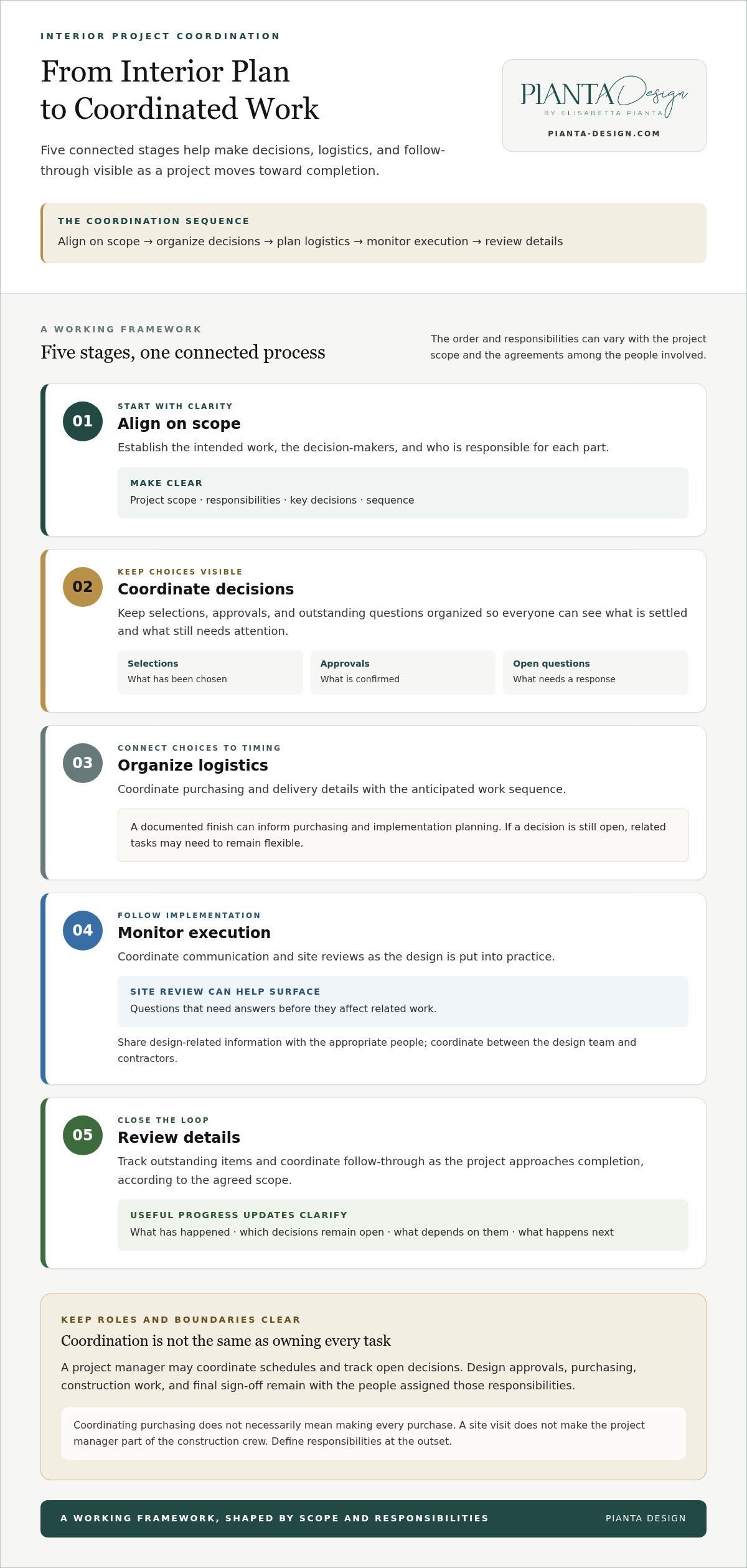
A design plan becomes buildable through a sequence of connected decisions, not a single handoff. The exact order and deliverables depend on the project scope and agreed responsibilities, but coordination often moves through five stages: align on scope, organize decisions, plan logistics, monitor execution, and review details. Each stage gives the next one clearer information to work with.
- Align on scope: Establish the intended work, decision-makers, and responsibilities.
- Coordinate decisions: Keep selections, approvals, and outstanding questions visible.
- Organize logistics: Connect purchasing and delivery details with the anticipated work sequence.
- Monitor execution: Coordinate communication and site reviews as implementation progresses.
- Review details: Track questions and follow-through as the project approaches completion.
This sequence is a working framework, not a universal checklist. A focused room update may need less coordination than a home renovation involving multiple spaces, custom elements, and several decision-makers. The responsibilities assigned to the project manager, designer, client, and contractor shape both the process and its pace.
How are design decisions and project logistics coordinated?
Selections influence what can be ordered, what needs approval, and how work is planned on site. For example, a finish should be documented clearly before it informs purchasing or implementation planning. If the decision is still open, related tasks may need to remain flexible. A project manager can maintain an organized record of selections, approvals, questions, and dependencies, so everyone involved can see what’s settled and what still needs attention.
That record also helps keep budget discussions tied to approved scope. If a proposed change affects the agreed work or a related selection, it can be identified and sent to the person responsible for approving it, rather than quietly treated as part of the original plan. Coordination connects design decisions with the people, information, and implementation steps needed to bring them into the room.
What happens during site visits and construction oversight?
A site visit provides an opportunity to compare visible progress with the design information and identify details that need clarification. A question about a finish, placement, or relationship between elements can be documented and shared with the appropriate people. The project manager can coordinate with the contractor and design team to clarify the intended detail and organize follow-up. The contractor performs the construction work; project oversight coordinates and reviews implementation but isn’t construction labor.
So, what does a design project manager actually do at this stage? The role helps bring questions to light while there’s a clear path to resolve them and keeps the next decisions understandable to the client. For residential projects that benefit from considering design and implementation together, Pianta Design’s project coordination connects planning with logistics, site visits, and quality control.
Design Project Manager, Interior Designer, and Contractor: Who Does What?
These roles meet around the same interior, but each brings a different responsibility. The interior designer shapes the space and its selections. The contractor carries out the construction work included in their agreement. Project management coordinates workflows and oversight so design information, decisions, and implementation stay connected. The exact division of responsibility depends on the project scope and agreements.
| Project responsibility | Interior designer | Design project manager | Contractor |
|---|---|---|---|
| Design intent | Develops the space, layout, and design selections. | Coordinates communication so relevant design information reaches the right people. | Uses the applicable project information to carry out contracted work. |
| Coordination | Clarifies design choices and related information. | Organizes schedules, logistics, open decisions, and follow-through within the agreed scope. | Coordinates construction activity as defined by the project setup. |
| Construction labor | Doesn’t perform construction labor by virtue of the design role. | Coordinates oversight, not construction labor. | Performs the construction work covered by the agreement. |
| Implementation review | May review how the work relates to the design intent, depending on responsibilities. | May coordinate site visits, questions, and quality-control follow-up within the agreed scope. | Addresses execution of contracted construction work. |
How is project management different from interior design?
Design authorship answers questions such as how a room should function, what its layout should achieve, and which materials and finishes support the vision. Project management focuses on how decisions, people, and practical steps are coordinated around that vision. In a residential renovation, for example, a designer may develop a kitchen’s layout and selections, while a project manager tracks decisions and coordinates communication as those plans move toward implementation. One firm can provide both design and oversight as related services, while keeping each responsibility clear.
How is a project manager different from a general contractor?
A contractor’s role is tied to executing construction work under the project’s construction agreement. A design project manager coordinates the broader workflow and may review implementation against the design intent, but doesn’t replace the contractor’s labor or construction responsibilities. Some projects have distinct design, management, and construction roles, while others combine certain functions. Clear agreements help everyone understand who is responsible for each decision, task, and follow-up.
Coordination isn’t duplication when responsibilities and communication are defined. A designer can focus on the quality and coherence of the space, a contractor can focus on contracted construction work, and a project manager can keep relevant information and dependencies visible between them. That distinction answers the practical question of what does a design project manager actually do: the role creates continuity between design decisions and implementation without claiming ownership of every task or outcome.
How to Tell Whether Your Interior Project Needs Project Management
Not every renovation needs the same level of oversight. A focused refresh with a handful of choices may be straightforward to coordinate; a project with several rooms, custom furnishings, numerous selections, or overlapping work can place greater demands on your time and attention. The useful question isn’t whether a project is inherently complicated, but whether its decisions and logistics need dedicated follow-through.
Use these prompts to assess where coordination may help:
- Scope: Are several rooms or phases being planned together, with decisions that affect one another?
- Decision-makers: Do multiple household members need to review or approve design choices?
- Purchasing: Are there many materials, finishes, or custom furnishings to coordinate with the project sequence?
- Site activity: Will work overlap, or will progress need regular review and communication?
- Distance: Will you be away from the property and rely on updates to follow what’s happening?
Which project conditions make coordination especially valuable?
A home renovation combining space planning, custom furniture, and many material selections may involve more interdependent decisions than a single-room update. If a finish choice affects purchasing or site planning, keeping its status clear helps connect the next steps. This applies to residential projects in Park City, Salt Lake City, San Francisco, and Miami: the project’s scope and your involvement matter more than the location alone. Distance can make timely updates and clear records particularly useful, though it doesn’t make every remote project complex.
Budgeting is another part of project planning. As you consider oversight needs, a guide to budgeting for a luxury interior design project can help frame the financial conversation alongside scope and priorities. Tie expected costs and approvals to your specific project rather than assuming one budget structure fits every home.
What should clients clarify before work begins?
Start by establishing what coordination covers and how it will work in practice. Decide who makes design decisions, who communicates them, and how changes or approvals will be documented. Define the expected communication cadence, whether site visits are part of oversight, and which review points matter as work progresses. These details help everyone understand where responsibility sits and how an open question moves toward resolution.
Pianta Design brings project oversight together with residential design, coordinating logistics, site visits, contractor supervision, and quality control. This connects planning and implementation as a project develops, with oversight shaped around its needs and agreed responsibilities. If you’re weighing the coordination your home project calls for, explore Pianta Design’s project management as part of your planning conversation.
How Pianta Design Connects Project Management with Interior Design
Interior design brings a home’s character and function into focus; project oversight helps carry those intentions through the practical details of implementation. At Pianta Design, residential design and project management work together, connecting planning and selections with the logistics and site activity that shape how a design is realized.
The firm’s oversight includes contractor supervision, logistics coordination, site visits, and quality control. These responsibilities keep design information and implementation in view, while construction work remains with the contractors engaged for the project. With more than 30 years of industry experience, Pianta Design brings an established perspective to the relationship between a considered interior and the work required to bring it to life.
How does integrated design oversight support a cohesive result?
Consider a residential project that includes revised space planning, custom furniture, and carefully selected materials. Each decision contributes to the character of the home and may also affect practical coordination. When a selection or site detail raises a question, clear communication among the design team, purchasing participants, and contractors helps keep the approved direction visible as work progresses. This is the design-specific answer to what does a design project manager actually do: connect the intent behind the plan with the information and follow-through needed during implementation.
That connection matters because coherence is expressed in more than a palette or a single beautiful object. Proportions, finishes, furnishings, lighting, and the way rooms support daily life all contribute to the experience of home. For readers interested in this relationship between design and living well, Pianta Design’s perspective on residential interior design and elevated luxury living offers a natural extension of the conversation.
Integrated oversight doesn’t mean every responsibility belongs to one person. Instead, it gives design decisions and practical coordination a shared context, while roles and deliverables remain shaped by the project’s scope and agreements. This can be especially valuable when a home’s spatial planning, custom elements, and material selections need to be considered together.
What can clients expect when beginning a project conversation?
A thoughtful first discussion can begin with the home itself: which spaces are under consideration, what the household wants to change, and what kind of experience the finished interiors should support. Priorities, project scope, decision-making, and the desired level of oversight help frame the work. From there, design services and coordination can be shaped around the project.
Pianta Design brings residential planning and design together with logistics coordination, site visits, contractor supervision, and quality review, keeping the relationship between design and implementation part of the planning conversation. Explore Pianta Design’s residential interior design services to consider how your home, priorities, and desired experience might shape a project.
Shape the Next Step for Your Home
Once you understand what does a design project manager actually do, you can approach your project with a clearer sense of the support it needs. Before work begins, consider what you want your home to make possible in daily life, which decisions matter most, and how involved you’d like to be as the design takes shape. Those priorities can guide a conversation about the right balance of creative direction and project oversight.
A thoughtful residential project starts with listening: to the character of the home, the people who live there, and the experience they hope to create. From there, design choices and coordination can be considered in relation to the project’s scope, rather than treated as a one-size-fits-all process.
Explore Pianta Design’s residential interior design services and begin imagining how your home could better reflect the way you want to live. Start a conversation about your home, priorities, and the level of design and project oversight that suits your project.
Frequently Asked Questions
What does a design project manager do every day?
A design project manager’s daily work changes with the project’s current needs. For example, a client reviewing several finish options might receive an update showing which choice is needed, what information supports it, and which upcoming task depends on it. The practical answer to what does a design project manager actually do is that the role turns scattered project details into clear next steps, with specific duties set by the agreed scope.
Is a design project manager the same as an interior designer?
No. An interior designer develops the design direction, while project management focuses on coordinating how agreed decisions move through the project. For example, the designer might resolve how a living room should feel and function; a project manager may organize the timing and communication around implementing those choices. A firm can provide both, but clients benefit from understanding which decisions are design-led and which coordination tasks fall within the project manager’s role.
Does a design project manager supervise contractors?
A design project manager can provide contractor oversight as part of the project scope. In practice, this could mean coordinating a design clarification when a planned detail raises a question during site work, then tracking the response so the relevant participants share the same understanding. That oversight doesn’t mean the project manager performs construction or takes on every contractor duty. The agreed responsibilities determine who executes work and who coordinates design-related communication.
When should I hire a project manager for an interior design project?
Consider project management when keeping up with decisions and dependencies would compete with your other responsibilities. A homeowner managing work across several rooms, coordinating custom furnishings, and balancing input from multiple household members may value structured oversight. It can also help if you’re not regularly at the property. For residential projects in Park City, Salt Lake City, San Francisco, or Miami, the right level of support depends on the home, scope, and your desired involvement.
Can an interior designer manage a project as well as design it?
Yes. An interior design firm can combine design services with project management or construction oversight. That arrangement creates continuity between design choices and the coordination needed to implement them. Before work begins, clarify who will communicate design updates, record approvals, coordinate contractor questions, and review progress. A shared understanding helps clients see where design decisions end, where coordination begins, and how the two responsibilities work together.
What is the difference between project management and construction management?
The terms can describe different responsibilities, so the title alone may not explain what a person will do on a particular project. Interior project management often centers on coordinating design decisions, communication, purchasing information, and oversight. Construction management may focus more directly on construction operations. Look at the project’s defined tasks, reporting relationships, and responsibility for handling questions that arise during implementation rather than assuming the labels mean the same thing everywhere.
How does a design project manager help keep a project on track?
A project manager supports progress by making dependencies and unresolved items easier to see. Suppose the next stage of a room’s work relies on a finish choice: the team can identify that decision, record its status, and communicate which work may depend on it. This visibility helps clients respond with context and understand the next steps. It can’t guarantee an unchanged schedule, since timing may be affected by project conditions, decisions, and agreed responsibilities.
