
The Luxury Furniture Procurement Process: The Complete 2026 Guide

Acquiring an exceptional bespoke interior is never an exercise in simple retail buying; it is an architectural discipline of engineering provenance. Yet, mastering the luxury furniture procurement process often introduces profound friction. You shouldn't have to endure the quiet anxiety of opaque overseas schedules, European lead times extending beyond twenty weeks, or the vulnerability of freight damage to one-of-a-kind commissions. Coordinating cross-border customs, specialized warehousing, and multi-layered logistics can easily eclipse the creative joy of shaping a home.
You already know that creating spaces of enduring elegance requires uncompromising standards and materials that can't be found in commercial showrooms. This guide reveals how high-end design firms orchestrate the entire acquisition journey, from commissioning generational European ateliers to white-glove delivery on site. You'll gain complete visibility into fabrication timelines, understand the logistical safeguards that protect your investment, and see how trade mastery translates complex architectural visions into flawless reality.
Key Takeaways
- Understand how the luxury furniture procurement process bridges pure architectural vision and technical artisan fabrication to protect your investment.
- Discover the five critical procurement milestones, including rigorous strike-off approvals, custom finishes, and proactive punch-list administration.
- Learn how seasoned design firms safeguard irreplaceable commissions through transatlantic customs navigation, bonded warehousing, and museum-grade crating.
- Explore how distinct geographic microclimates, from high-salinity coastal air to alpine UV exposure, dictate bespoke joinery, metal alloys, and textile performance.
- Uncover how multi-generational relationships with master Italian workshops unlock custom heirloom pieces entirely inaccessible within retail showrooms.
What Is the Luxury Furniture Procurement Process in High-End Design?
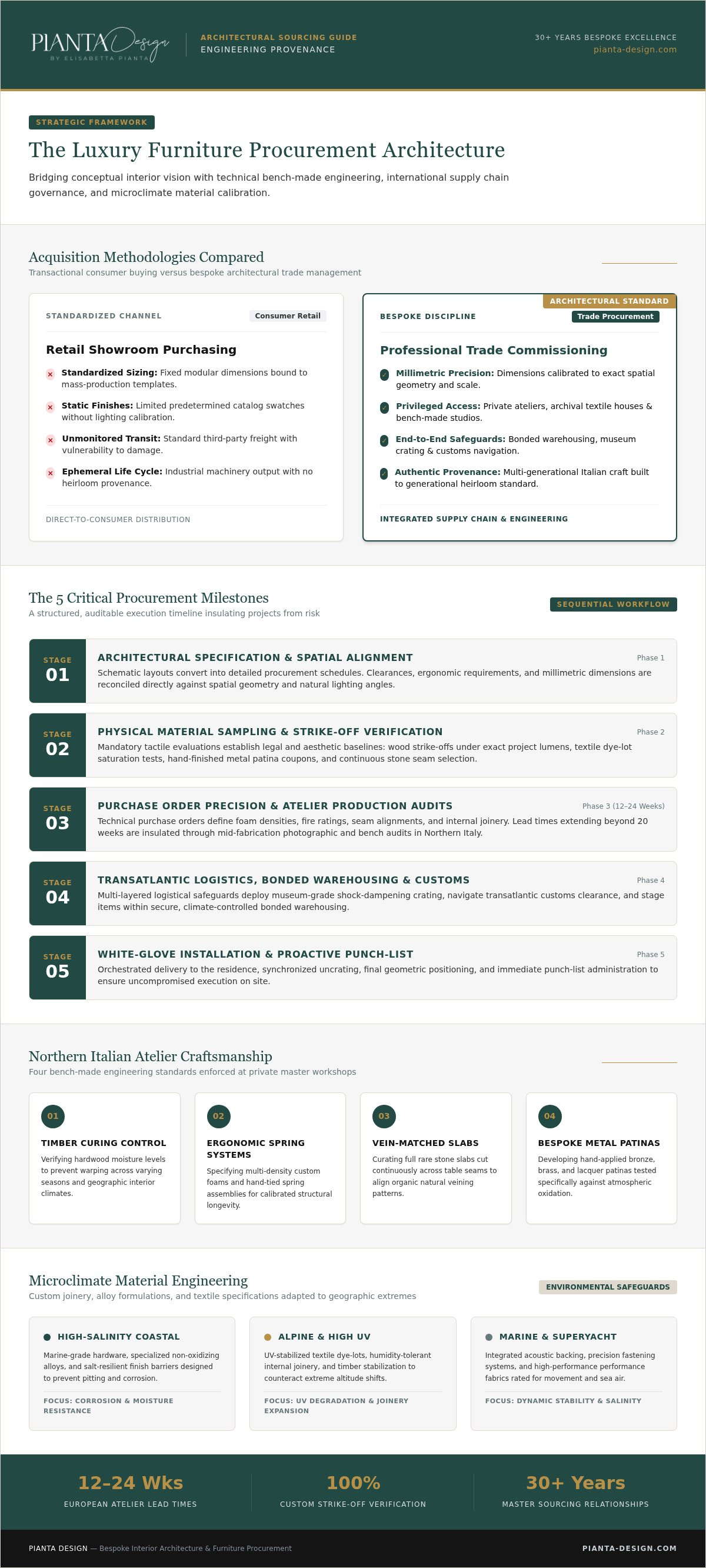
True luxury is never retrieved from a commercial warehouse shelf. The luxury furniture procurement process functions as an integrated architectural specification and acquisition methodology. It bridges conceptual interior design with technical, bench-made engineering, ensuring every commissioned piece responds directly to the spatial geometry, natural light, and structural scale of a home. Rather than simple transactional purchasing, this discipline applies the principles of specialized supply chain management to orchestrate raw material provenance, custom artisan fabrication, and strict risk mitigation across international borders. Overseeing every stage protects the client against catastrophic freight damage, dimension errors, and manufacturing defects.
Retail Purchasing vs. Professional Trade Procurement
High-end retail showrooms offer convenience, yet their collections remain bound to standardized sizing, mass-production templates, and static finish options. Trade procurement operates on an entirely distinct level of precision. When an experienced interior designer commissions a piece, dimensions are adjusted down to the millimeter to preserve spatial balance. Furthermore, professional trade access unlocks private workshops, archival textile houses, and bench-made framing studios that refuse direct-to-consumer orders, ensuring your furnishings remain genuinely exclusive and calibrated to your environment.
The Power of Direct Atelier Relationships and Italian Craftsmanship
The soul of bespoke design lies in privileged maker access. Multi-generational ateliers in Northern Italy preserve century-old traditions in wood curvature, hand-applied patinas, and tailored upholstery that industrial machinery can't replicate. Working directly with these master artisans allows designers to enforce rigorous fabrication standards, including:
- Verifying hardwood timber curing and moisture contents to prevent seasonal warping.
- Selecting hand-tied spring systems and custom foam densities for lasting ergonomic support.
- Specifying rare stone slabs cut continuously across table seams to align natural veining.
- Developing bespoke bronze and lacquer patinas tailored to the project's exact palette.
Direct atelier collaboration guarantees that the final piece represents an enduring heirloom of authentic provenance rather than an ephemeral trend.
The 5 Key Stages of an End-to-End Bespoke Procurement Workflow
Executing an uncompromising interior demands a linear, auditable sequence. Rather than relying on guesswork, a structured luxury furniture procurement process harmonizes creative vision with rigorous mechanical execution, ensuring every bespoke commission aligns with the wider residential interior design timeline. In the broader international furniture market, where multi-step global manufacturing demands extreme precision, an established workflow insulates projects from operational disruption.
Phase 1 & 2: Architectural Specification, Curation, and Sampling
Schematic layouts transform into detailed procurement schedules outlining exact dimensions, clearances, and structural requirements. Before authorizing fabrication, teams execute rigorous physical material sign-offs:
- Wood strike-offs evaluated under project-specific lighting to verify undertones.
- Textile dye-lot verification confirming color saturation and tactile weave.
- Hand-finished metal coupons tested for consistent patina depth and oxidation resistance.
- Full-slab stone selection ensuring natural fissures match structural joinery lines.
These tactile evaluations establish legal and aesthetic baselines, preventing misinterpretation by international craft ateliers.
Phase 3: Purchase Orders, Production Tracking, and Quality Audits
Clarity at the purchase order stage eliminates costly misunderstandings. Every document specifies custom foam densities, domestic fire ratings, exact seam placements, and internal joinery methods. During the standard twelve to twenty-four weeks required for European artisan production, proactive milestone tracking keeps fabrication on schedule. Mid-production bench reviews and dimensional audits verify structural integrity long before items enter their shipping crates.
Phase 4 & 5: Secure Freight Consolidation and White-Glove Staging
Disjointed parcel arrivals disrupt luxury environments. Sourced components travel via specialized freight forwarders directly to bonded, climate-controlled receiving warehouses. Receiving technicians inspect every crate, document unboxing conditions photographically, and store items safely until the residence is construction-ready. Once site dust clears, a single white-glove staging day places every element according to strict architectural plans, followed by meticulous punch-list resolution.
Discerning homeowners seeking seamless execution often collaborate with Pianta Design to orchestrate complex trade procurement with complete peace of mind.
Navigating International Logistics: Customs, Warehousing, and Freight Protection
The transatlantic journey of bespoke furnishings exposes irreplaceable craft pieces to severe physical and regulatory hazards. Sourcing from premier ateliers requires specialized operational stewardship to protect against transit shocks, maritime humidity, and port delays. Without an experienced team directing the luxury furniture procurement process, cross-border shipments risk administrative impoundment or irreparable structural damage.
Customs Compliance, Import Tariffs, and International Transit
Transporting heirloom commissions into the United States involves stringent regulatory frameworks. Professional logistics oversight manages these complex checkpoints:
- Accurate Harmonized Tariff Schedule (HTS) classifications to ensure proper duty application and avoid costly audit holds.
- Mandatory ISPM-15 phytosanitary certifications for solid timber and raw wood crating to satisfy agricultural border controls.
- End-to-end maritime and air transit insurance covering the full appraised value of custom commissions rather than baseline freight weight limits.
- Trusted customs brokerage partnerships that expedite clearances at key entry ports.
Custom fabrications also require tailored crating. Fragile slabs of Calacatta marble, mirrored installations, and high-gloss polyester lacquers demand custom internal foam blocking, vapor barriers, and shock sensors that register rough transit handling.
The Critical Role of Receiving Warehouses and Condition Audits
Delivering unverified foreign crates straight to an active residential job site is a disastrous mistake. Construction sites harbor fine gypsum dust, trades traffic, and fluctuating ambient moisture that quickly ruin delicate finishes. Instead, all transatlantic shipments route through vetted, regional receiving warehouses equipped with climate-monitored vaults.
Receiving managers execute an exhaustive inspection protocol within twenty-four hours of delivery. Teams uncrate each piece, perform a complete 360-degree condition audit, and take high-resolution photographs to identify concealed freight damage while transit insurance claims remain valid. Items are then securely repacked and stored in climate-controlled bays. This intermediate staging allows the complete interior collection to accumulate safely, enabling a flawless, single-day white-glove installation once architectural construction completes.
Tailoring Procurement to Distinct Environments: Coastal, Alpine, and Marine Settings
A bespoke interior must harmonize with its immediate microclimate as much as its floor plan. Atmospheric conditions dictate how natural textiles age, how dense woods expand, and how metallic accents oxidize over time. When designers integrate climate science into the luxury furniture procurement process, they ensure that investment-grade furnishings retain structural stability and visual depth indefinitely. Tailoring material science to geography is a fundamental cornerstone of refined custom furniture design.
Coastal and Marine Specifications: San Francisco Bay and Miami
High relative humidity and ocean salt mist attack ordinary interior finishes relentlessly. Coastal residences and superyachts demand specialized material engineering before orders are released to the workshop:
- Structural framework: Grade 316 marine stainless steel and solid plantation teak to prevent galvanic oxidation and dry rot.
- Performance textiles: Solution-dyed acrylics and breathable, anti-microbial indoor-outdoor weaves that resist mildew and salt retention.
- Joinery and glues: Moisture-curing polyurethane adhesives that won't delaminate under sustained tropical dampness.
- Marine compliance: Rigorous adherence to weight restrictions, non-combustibility mandates, and hidden mechanical floor anchoring systems for maritime vessels.
These specialized choices insulate oceanfront properties from early aesthetic degradation without sacrificing the tactile richness of custom upholstery.
High-Altitude Climate Resilience: Park City and Salt Lake City
Mountain retreats face the opposite challenge. High-elevation atmospheres combine single-digit winter indoor humidity with intense ultraviolet radiation that bleaches organic pigments. Solid European timber commissions destined for alpine chalets require meticulous kiln-drying schedules to achieve moisture contents below eight percent; otherwise, internal tensions induce sudden surface checks and split veneer lines once whole-home heating engages.
Upholstery selections in mountain environments prioritize densely woven European wools, plush bouclés, and deeply vegetable-tanned, oil-conditioned Italian hides. These substantial skins resist the brittle drying and creasing common to dehydrated climates. Atelier fabrications also receive invisible, non-film UV blockers across natural linens and dyes, protecting seating from degradation near expansive, south-facing glass vistas.
For custom residences across both oceanic and alpine terrains, you can consult Pianta Design to engineer bespoke furnishings tailored precisely to your property's regional climate.
The Pianta Design Advantage: 30+ Years of Bespoke Sourcing Excellence
Mastery over high-end procurement isn't built overnight. For over three decades, Maria Pianta has guided discerning clients through the complexities of international acquisition across San Francisco, Miami, Park City, and Salt Lake City. Elevating the luxury furniture procurement process beyond administrative management, Pianta Design treats sourcing as an extension of spatial planning and interior architecture, ensuring every commissioned piece fits its spatial volume and functional purpose seamlessly.
Direct Italian Provenance and Custom Commissioning
Decades of on-site collaboration have established direct, enduring partnerships with multi-generational Italian fabricators that standard retail channels can't access. These private relationships grant clients distinct creative advantages:
- Direct sourcing of rare natural stone directly from historic Tuscan quarries, matched precisely across individual slab cuts.
- Custom foundry work for lost-wax bronze casting, creating structural table bases and architectural hardware with hand-rubbed patinas.
- Collaborations with heritage textile mills in Northern Italy to produce exclusive woven velvets and tailored damasks.
- Custom case goods engineered specifically to complement whole-home architectural paneling and millwork.
These long-standing relationships eliminate intermediary layers, granting exceptional control over provenance, craftsmanship, and fabrication fidelity.
A Turnkey, White-Glove Client Experience
Bespoke commissions should inspire excitement, not logistical fatigue. Pianta Design provides end-to-end stewardship, managing manufacturer contracts, currency conversions, customs documentation, and scheduled freight milestones with meticulous discretion. Clients bypass the stress of coordinating multiple foreign vendors or navigating port logistics independently.
The journey culminates in a carefully synchronized installation. The firm oversees the arrival of every piece from bonded storage, directing white-glove placement, fine art positioning, and interior styling according to exact architectural plans. If you are ready to curate an extraordinary environment free from operational compromise, discover Pianta Design and experience how thirty years of bespoke expertise transforms exceptional design visions into reality.
Elevating Your Space Through Masterful Procurement
Creating an exceptional living environment shouldn't become an exercise in logistical endurance. An expertly orchestrated luxury furniture procurement process bridges the gap between ambitious architectural drawings and tangible, heirloom-quality furnishings. By combining rigorous material testing with transatlantic freight protection and climate-tailored specifications, bespoke sourcing protects both your investment and your peace of mind.
Backed by over 30 years of premier luxury interior design experience, direct relationships with multi-generational Italian artisans, and full-service project management across California, Florida, and Utah, our studio ensures your home achieves effortless distinction. Begin Your Bespoke Interior Journey with Pianta Design and let us transform your vision into an enduring sanctuary of timeless beauty.
Frequently Asked Questions
What is the typical lead time for bespoke luxury furniture procurement?
Domestic custom fabrications typically require eight to sixteen weeks, whereas imported commissions from European ateliers require twelve to twenty-four weeks or longer. For complete residences in destinations like Miami or Park City, procurement planning begins six to nine months before targeted completion. This extended timeline accommodates custom finish strike-offs, bench-made artisan craftsmanship, transatlantic maritime freight, customs clearance, and receiving inspections.
Why should an interior designer manage procurement instead of the client ordering directly?
Direct ordering leaves property owners vulnerable to opaque overseas manufacturing schedules, freight liability disputes, and costly dimensional errors. When a professional designer directs the luxury furniture procurement process, architectural drawings translate into ironclad purchase orders. The firm handles trade communications, navigates complex customs import duties, conducts rigorous quality audits, and ensures every bespoke commission aligns with the wider spatial envelope.
How are shipping damages and manufacturing defects handled during luxury procurement?
Bespoke shipments bypass the job site and route directly to specialized receiving warehouses where technicians uncrate and inspect every angle within twenty-four hours. If transit damage or fabrication flaws emerge, the design team files immediate marine transit claims and coordinates directly with Italian workshop managers. Remediation, refinishing, or component remanufacturing occurs discreetly off-site before the item ever arrives at your home.
What is the difference between purchasing from a retail showroom and trade-only sourcing?
Retail showrooms offer fixed-dimension catalog pieces produced in mass batches with preselected textiles and finishes. Trade-only sourcing grants direct access to multi-generational European ateliers, private stone quarries, and archival fabric mills. Through trade channels, an interior designer customizes every dimension, seat depth, foam density, and hand-applied metal patina, creating an authentic, bench-made heirloom unattainable on the consumer market.
Can custom luxury furniture be engineered for harsh mountain or coastal climates?
Yes, climate engineering is an essential part of bespoke sourcing. Oceanfront estates in Miami and San Francisco Bay demand grade 316 marine stainless steel, anti-microbial cushion cores, and solution-dyed textiles resistant to salt air. Conversely, alpine chalets in Park City and Salt Lake City require hardwoods kiln-dried below eight percent moisture to avoid winter shrinkage, alongside UV-inhibited textiles that withstand high-altitude solar exposure.
What role does a climate-controlled receiving warehouse play in luxury design projects?
A receiving warehouse functions as a secure staging sanctuary throughout the luxury furniture procurement process. Delivering fragile lacquers, hand-knotted rugs, and custom upholstery directly to an active construction site invites catastrophic dust and trades damage. Dedicated facilities hold, inventory, and protect your investments in temperature-regulated vaults until construction clears, allowing the entire interior to be revealed in a single, synchronized installation day.
