
Designing a Custom Wine Cellar: Architectural Elegance Meets Sommelier Precision
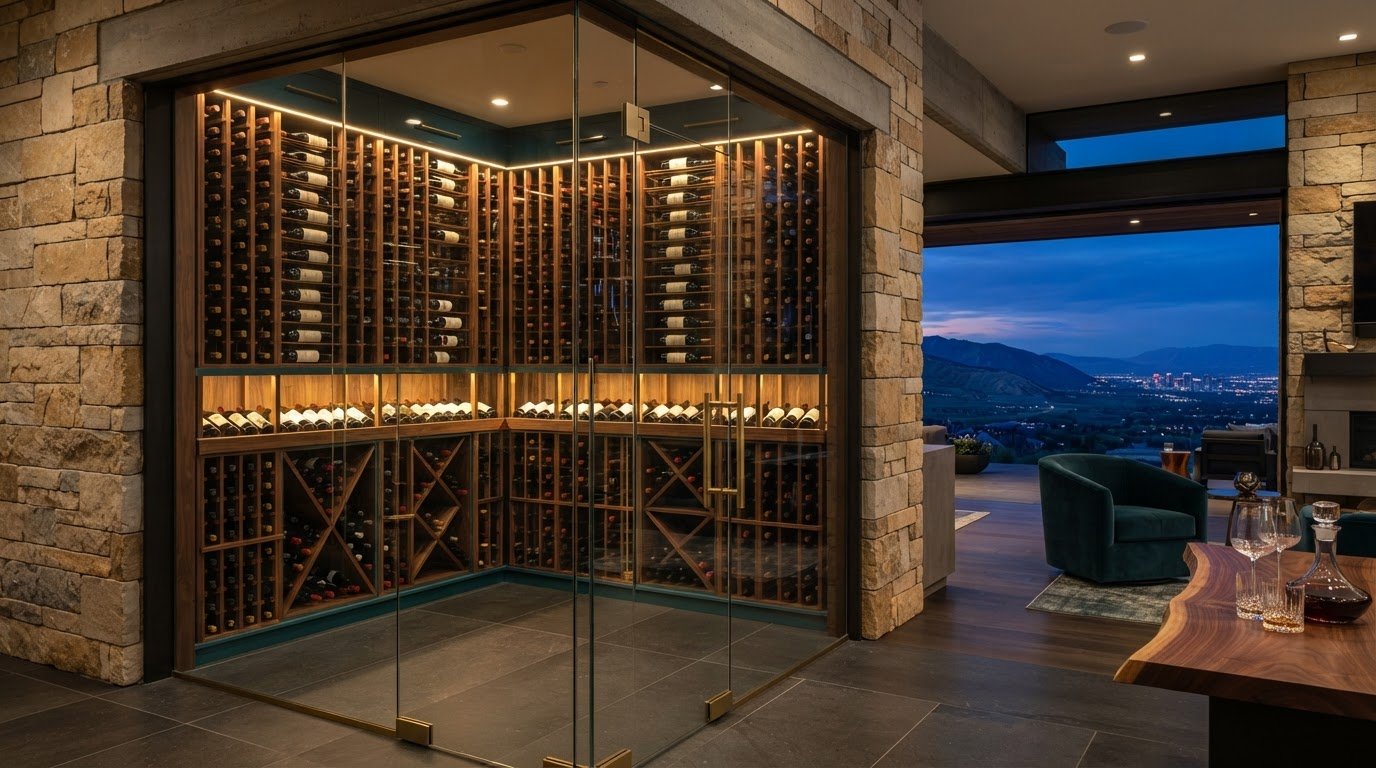
A true luxury wine cellar is an architectural gallery celebrating terroir, never merely a mechanical cold-storage room hidden beneath the floorboards. Yet when designing a custom wine cellar, collectors often find themselves caught between two demanding disciplines: the uncompromising thermodynamics required to age rare vintages and the refined interior architecture of an estate.
You know the quiet anxiety of entrusting irreplaceable bottles to an unproven environment. The dread of cork rot, hidden mold, or micro-vibrations ruining delicate flavor profiles is entirely justified, especially when utilitarian racking systems don't match the sophisticated character of your living spaces.
Discover how to design a bespoke wine sanctuary that balances strict preservation physics with breathtaking interior architectural design. Ahead, we explore the essential principles behind hermetic thermal envelopes, silent split refrigeration, and custom artisan millwork that turn your collection into an exquisite centerpiece for effortless entertaining.
Key Takeaways
- Understand how designing a custom wine cellar elevates fine storage from a hidden basement cache into an architectural showcase integrated directly into your living spaces.
- Explore the critical environmental physics behind airtight thermal envelopes, warm-side vapor barriers, and silent refrigeration that protect delicate vintages from spoilage.
- Discover which non-aromatic hardwoods, bespoke metalwork, and zero-VOC finishes endure sustained humidity without releasing volatile compounds into aging bottles.
- Uncover the technical glazing standards and zero-UV lighting specifications needed to eliminate light-strike risks while presenting your collection in gallery-grade radiance.
- Learn how master spatial planning and expert trade coordination seamlessly unite complex mechanical engineering with sophisticated residential interior design.
The Architectural Vision: Moving Beyond Basic Cold Storage
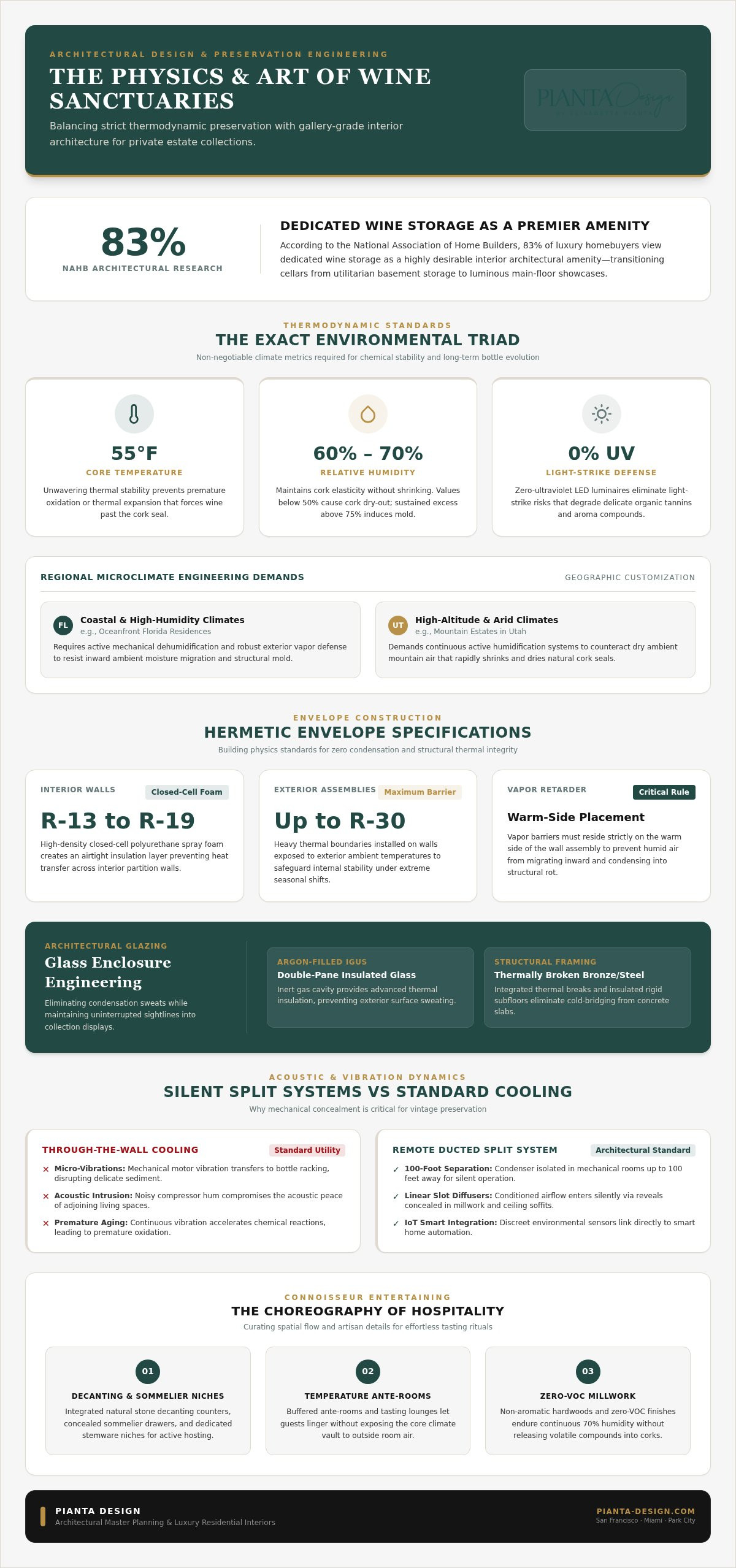
Historically, private wine collections languished in damp subterranean basements, treated as hidden utility reserves rather than design opportunities. Today, that perspective has fundamentally changed. Fine vintage storage has emerged as an expressive interior architectural showcase, transforming into a luminous jewel box that anchors the principal entertaining spaces of an estate. Research from the National Association of Home Builders indicates that 83% of luxury homebuyers view dedicated wine storage as a highly desirable interior architectural amenity. Designing a custom wine cellar is no longer an exercise in stacking modular racks into an unfinished closet; it's the deliberate curation of sightlines, tactile materials, and hospitality.
Achieving this balance requires rigorous space planning. The layout must orchestrate bottle capacity and human movement ergonomics simultaneously, ensuring that retrieving an aged Barolo feels like exploring a curated gallery rather than reaching into an oversized appliance.
Spatial Planning and Location Strategies Within the Home
Modern luxury residences increasingly elevate wine storage to the main floor. While subterranean foundations offer passive geothermal buffers, prominent above-ground glass enclosures turn collections into dramatic centerpieces adjacent to formal dining rooms, central galleries, or beneath sculptural floating staircases. Thoughtful spatial programming balances guest accessibility during formal dinner parties with secure zoning, guaranteeing that everyday foot traffic never compromises fragile vintage preservation.
Designing for the Connoisseur's Entertaining Rituals
A masterfully conceived cellar embraces the choreography of hospitality. Incorporating integrated stone decanting counters, concealed sommelier drawers, and dedicated stemware niches transforms storage into an active tasting environment. For avid hosts, planning a temperature-buffered ante-room or an adjoining tasting lounge allows guests to linger over unhurried flights in acoustic serenity, savoring delicate flavor notes without continuously exposing the core climate vault to ambient room air.
The Physics of Preservation: Technical Foundations for Longevity
Wine aging is delicate chemistry governed by thermodynamics. When designing a custom wine cellar, long-term bottle evolution demands adherence to an exact environmental triad: an unwavering 55°F, 60% to 70% relative humidity, and complete protection from ultraviolet light. Sustaining this precise microclimate varies dramatically across geographic regions. An oceanfront residence in humid coastal Florida requires active dehumidification and robust vapor defense, whereas a mountain estate in high-altitude Utah demands constant humidification to keep natural corks from drying and shrinking.
Thermal Envelopes, Vapor Barriers, and Insulation R-Values
Flawless preservation rests on an impenetrable thermal envelope. High-density closed-cell polyurethane spray foam creates a seamless air barrier and vapor retarder, achieving R-13 to R-19 thermal boundaries for interior walls and up to R-30 for exterior assemblies. The vapor barrier must always reside on the warm side of the wall assembly to prevent humid air from migrating inward and condensing into structural rot. For glass showcases, double-pane insulated glass units with argon gas fills and thermally broken bronze or steel frames prevent surface sweating, while insulated rigid subfloors eliminate thermal bridging from concrete slabs.
Quiet Climate Systems and Mechanical Concealment
Noisy through-the-wall cooling units generate invasive acoustic hums and micro-vibrations that can disrupt delicate bottle sediment and accelerate premature oxidation. Refined estates replace these clumsy appliances with remote ducted split refrigeration systems. By placing the condenser in a dedicated mechanical space up to 100 feet away, conditioned air enters the room silently through linear slot diffusers concealed within custom ceiling reveals and cabinetry soffits.
Working alongside specialist trade partners to coordinate mechanical refrigeration, a seasoned interior architecture and design firm bridges technical engineering with refined aesthetics, integrating discreet IoT environmental sensors directly into smart home automation to protect your rarest vintages without disrupting the quiet luxury of your home.
Bespoke Materials and Artisan Detailing
Every finish inside a refrigerated wine room must reconcile aesthetic beauty with environmental endurance. Because a cellar maintains a perpetual 60% to 70% relative humidity, choosing the right palette is as much a chemical decision as a visual one. Off-the-shelf catalog racks and standard cabinetry finishes often release volatile organic compounds (VOCs) that can slowly migrate through natural corks, irrevocably tainting fine vintages. Designing a custom wine cellar calls for intentional, inert, and non-aromatic materials that remain stable under continuous refrigeration while providing a tactile backdrop for an evolving collection.
Freestanding center islands and sommelier presentation stations require the same meticulous discipline. Tailored through dedicated custom furniture design, these functional centerpieces ground the room with bookmatched marble waterfall ledges, leather-lined accessories drawers, and integrated display plinths that elevate uncorking into an intimate ritual.
Selecting Humidity-Stable Hardwoods and Fine Finishes
Modern luxury design has shifted toward rift-sawn American white oak and black walnut. White oak is naturally dense; its cellular pores are plugged with tyloses, creating organic resistance to rot and moisture absorption without the pungent smell of traditional all-heart redwood. Woods like aromatic red cedar must always be avoided, as their strong natural resins contaminate wine aromatics. Every timber surface should cure fully before installation, treated solely with odorless, water-based coatings or food-grade mineral oils.
Modern Metalwork, Suspended Rods, and Floating Racking
Precision metal fabrication introduces visual lightness to contemporary cellars. Slender rod systems and suspended tension cables turn bottles into floating sculptures, showcasing estate labels horizontally rather than hiding them neck-out in dark cubbies:
- Label-Forward Rod Arrays: Minimalist horizontal supports crafted from hand-rubbed brass or satin-black stainless steel ensure rapid visual identification while cradling bottles securely.
- Architectural Balance: Pairing high-density lower bins with softly lit presentation cradles gives large collections breathing room.
- Textural Backdrops: Mounting custom metal displays against vertical slabs of fluted limestone, honed quartzite, or bookmatched travertine introduces natural geology that echoes the mineral terroir of the bottles themselves.
When designing a custom wine cellar, integrating bespoke Italian metalwork alongside hand-finished natural stone creates an environment where timeless artisan joinery meets purposeful sommelier precision.
Atmospheric Lighting and Glass Enclosure Design
A glass wine showcase must reveal the depth of an estate collection without subjecting it to environmental stress. Illumination and glazing sit at the direct intersection of aesthetic drama and chemical vulnerability. Light wavelengths below 450 nanometers trigger photochemical reactions known as light strike, or goût de lumière, which can ruin delicate sulfur compounds in champagne and vintage whites. When designing a custom wine cellar, photic precision and structural glass engineering must work in concert, preserving every bottle while rendering the enclosure as a glowing architectural jewel box.
Light-Strike Prevention and Architectural Fixture Placement
Safeguarding wine from photic degradation requires zero-UV, low-heat LED fixtures with high color fidelity (90+ CRI). Specifying warm color temperatures between 2700K and 3000K ensures authentic label legibility while imparting a rich, amber radiance to the bottles. Millwork should conceal micro-channel LED ribbons beneath shelf nosings and inside vertical reveals, washing backdrop masonry in soft grazing light rather than casting direct glare onto the glass. Automated motion sensors and timed dimming scenes linked to home control systems keep active illumination periods brief, illuminating the collection during evening entertaining and returning it to restorative darkness overnight.
Structural Glass Engineering and Condensation Control
Showcasing a cooled 55°F cellar directly against an ambient 72°F living space creates severe thermal tension. Single-pane frameless glass simply cannot handle this temperature gradient; it condenses moisture immediately, obstructing sightlines and spilling water onto adjacent hardwood floors. True architectural clarity requires double- or triple-pane insulated glass units (IGUs) filled with argon gas:
- Low-Iron Clarity: Premium low-iron glass eliminates the greenish tint typical of standard float glass, rendering true vintage colors and label graphics without distortion.
- Anti-Reflective Coatings: Optical anti-reflective treatments minimize surface glare, allowing dinner guests to look directly into the cellar display without distracting reflections.
- Thermally Broken Frameworks: Polyamide insulating strips within slim-profile bronze or steel mullions stop thermal bridging, while concealed magnetic perimeter gaskets and automatic mechanical drop sweeps create an airtight seal at the threshold.
If you're ready to integrate a pristine, condensation-free wine showcase into your estate, consult with Pianta Design to orchestrate your lighting design and architectural glass specifications with absolute precision.
The Comprehensive Design and Implementation Process
Executing a bespoke wine room transcends simply purchasing racking or dropping an HVAC condenser into a utility closet. True excellence begins with thorough architectural orchestration. When designing a custom wine cellar, technical MEP refrigeration engineering must integrate seamlessly into the broader scheme of your residential interior design. Achieving this requires an intentional, multi-phase methodology that aligns structural realities with your aesthetic vision.
Collection Audits and Tailored Spatial Programming
The design journey starts with a rigorous collection audit rather than arbitrary measurements. Bottle silhouettes dictate millwork clearances; standard Bordeaux racks fail to accommodate the broader shoulders of Burgundy or Champagne bottles, while magnum formats require reinforced structural cradles. Spatial planning evaluates:
- Format Ratios: Calculating exact percentages between standard 750ml bottles, wider grower champagnes, and oversized collector formats.
- Acquisition Trajectories: Projecting five-to-twenty-year collection growth to establish appropriate storage density versus showcase displays.
- Case Allocation: Balancing immediate-access presentation racks with discreet staging zones for original wooden crates.
Turnkey Design Management and Environmental Commissioning
Translating conceptual sketches into reality demands close coordination between the interior architect, MEP refrigeration engineers, and master builders. While specialist trade partners execute the physical HVAC installation and general contracting labor, the designer acts as the lead orchestrator. This leadership ensures every custom reveal, stone slab, and millwork joint aligns perfectly with mechanical rough-ins before framing closes.
Before any vintage rests on a cradle, the completed envelope undergoes 72 hours of uninterrupted environmental stress testing. Calibrated thermal imaging verifies there is no thermal bridging along thresholds or glazing channels. Smart climate sensors connect directly to your digital inventory system, guaranteeing your cellar is fully commissioned to protect your rarest acquisitions.
Transforming Fine Storage into an Architectural Legacy
A private wine sanctuary shouldn't merely manage temperature; it should reflect your passion for collecting and elevate how you live and entertain. When designing a custom wine cellar, true success lies in the harmony between sommelier-level climate control and timeless interior architecture. From hermetic vapor envelopes to custom millwork and photically safe illumination, every subtle detail safeguards your liquid investments while providing an exquisite visual experience.
Bringing this level of refinement to life requires an experienced design partner. Backed by over 30 years of premier luxury residential interior architecture experience across California, Florida, and Utah, Pianta Design bridges complex MEP refrigeration engineering with bespoke artisan fabrication. Through direct partnerships with elite Italian makers, we orchestrate spaces that feel effortless, evocative, and enduring. Schedule a Design Consultation with Pianta Design to begin shaping a museum-grade showcase worthy of your finest vintages.
Frequently Asked Questions
What is the ideal temperature and humidity for a custom residential wine cellar?
The ideal preservation benchmark is a steady 55°F (13°C) and 60% to 70% relative humidity. Daily temperature fluctuations must stay within 1.5°F to prevent liquid expansion that pushes corks outward. Maintaining relative humidity above 50% prevents natural corks from drying and shrinking, while keeping it under 70% stops mold growth on paper labels. This stable microclimate ensures slow, graceful biochemical maturation.
Can a custom wine cellar be built on the main living floor rather than the basement?
Yes, main-floor installations are now the premier standard for luxury residential estates. Modern collectors prioritize visible glass showcases adjacent to dining rooms or great rooms over subterranean basements. Building above ground requires careful spatial planning, an insulated thermal envelope with continuous closed-cell spray foam, and high-performance insulated glazing to isolate the conditioned space from ambient living temperatures.
Why is standard residential air conditioning insufficient for cooling a wine room?
Standard home air conditioning systems cool spaces to around 70°F while actively stripping moisture down to 30% or 40% relative humidity. Wine requires a constant 55°F and at least 60% humidity. Residential HVAC equipment cools too quickly and dehumidifies aggressively, drying out natural corks and causing rapid oxidation. A dedicated wine refrigeration system cools gently to maintain essential moisture levels without thermal shock.
How do climate conditions in Miami, San Francisco, and Park City change cellar engineering?
Regional climates dictate vapor barrier positioning and mechanical equipment sizing. In humid Miami, cellars battle severe external moisture drive, demanding robust exterior vapor retarders and dedicated dehumidification. In high-altitude Park City or Salt Lake City, ultra-dry winter air requires integrated steam humidifiers to protect corks. San Francisco's coastal marine climate presents moderate temperatures but requires careful condensation mitigation along exterior building envelopes.
What types of wood are safest to specify for luxury wine cellar millwork?
Dense, non-aromatic hardwoods such as rift-sawn American white oak and black walnut are the safest choices for cellar millwork. White oak contains tyloses, an organic cellular structure that resists moisture decay and mold in 60% humidity. Clear all-heart redwood also performs reliably. Never specify aromatic cedar or solvent-based finishes, as volatile chemical compounds easily penetrate natural corks, permanently spoiling wine aromatics.
How many bottles should I plan to accommodate when designing a custom wine cellar?
When designing a custom wine cellar, plan for at least 25% to 30% more capacity than your current inventory. Wine collections expand naturally over time through allocations and auction purchases. A comprehensive spatial audit catalogs your ratio of standard Bordeaux bottles, wide Burgundy shapes, champagnes, and magnums. Allocating dedicated bulk-case storage alongside single-bottle presentation cradles ensures your cellar accommodates future acquisitions without sacrificing visual order.
How do interior designers conceal mechanical cooling units in glass-enclosed wine displays?
Designers conceal mechanical cooling by specifying remote ducted split refrigeration systems rather than self-contained wall units. Air handlers and compressors sit in distant mechanical rooms, connected by hidden refrigerant lines. Inside the showcase, conditioned air is delivered and returned through flush linear-slot diffusers integrated into architectural ceiling reveals or bespoke millwork headers. This eliminates visible grills, mechanical noise, and harmful equipment vibrations.
What is the difference between single-pane and insulated double-pane glass for wine rooms?
Single-pane glass lacks thermal separation, while double-pane insulated glass units (IGUs) maintain an airtight thermal barrier. When designing a custom wine cellar with glass walls, single-pane glass sweats chronically due to the temperature differential between the 55°F interior and warm living spaces. Double-pane IGUs feature argon gas fills, low-E coatings, and thermally broken frames that prevent condensation, eliminate thermal transfer, and filter harmful UV rays.
