
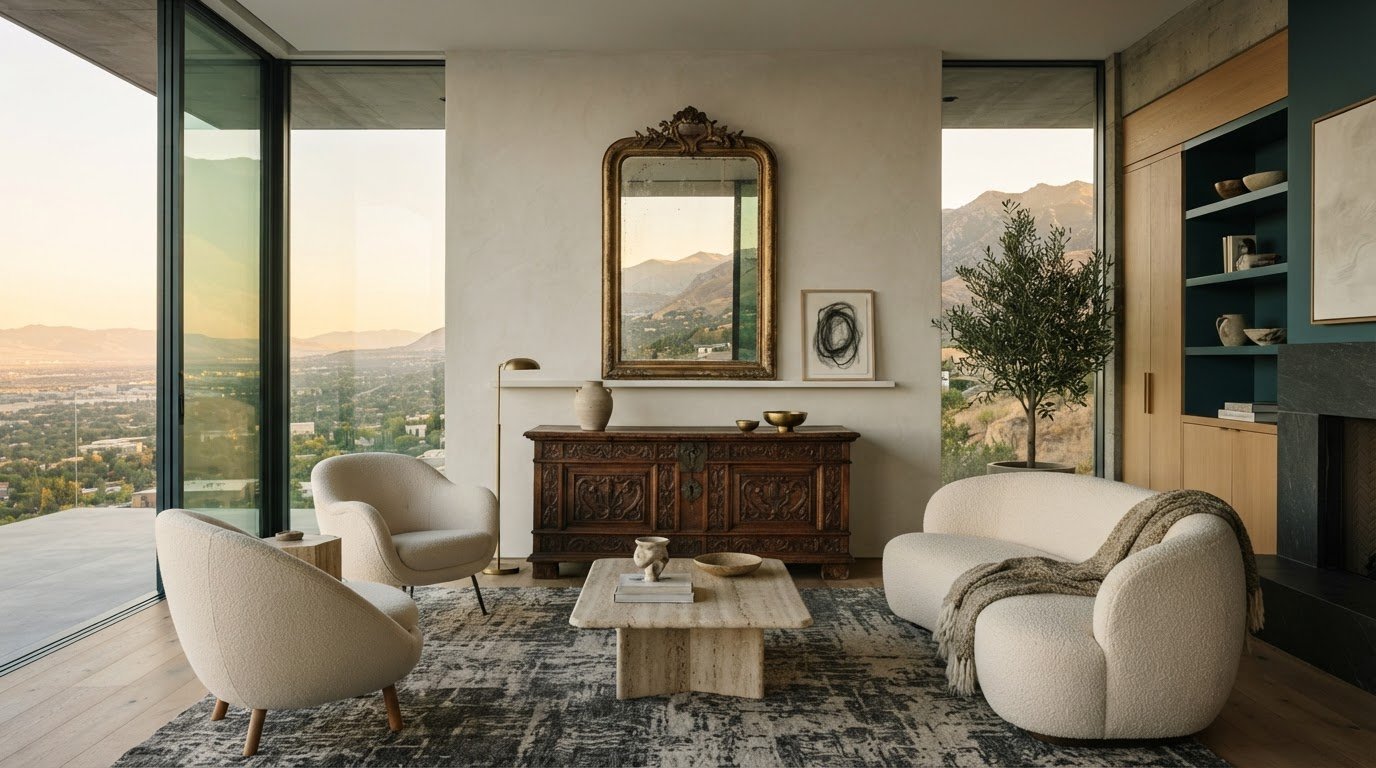
What if an antique didn’t need to match a modern room to belong in it? A carved chest, timeworn mirror, or sculptural chair can bring depth and history to contemporary interiors, but without thoughtful placement, even a treasured piece may feel out of scale or disconnected. The art of integrating antiques into a modern design lies not in recreating a period room, but in letting each object offer a deliberate counterpoint.
If you’ve hesitated to mix old and new for fear of visual clutter, that instinct makes sense. Antiques have distinctive proportions, finishes, and patina. They need room to stand out without competing with every other detail. With a considered approach, those contrasts can make a home feel layered and personal rather than themed.
This guide will help you choose which pieces to feature and balance their scale, materials, and character with contemporary furnishings. We’ll explore color, texture, space planning, and everyday function, so each antique feels connected to the room around it. The result can be a coherent, comfortable interior where history and modern living sit naturally together.
Key Takeaways
- Integrating antiques into a modern design begins with deciding what role a piece should play, then considering its scale in relation to the room.
- Use a statement antique as a focal point, or let smaller pieces add quieter notes throughout the space.
- Assess the room’s purpose, architecture, palette, and furnishings before settling on placement.
- Thoughtful contrast and restrained surroundings help distinctive antique details feel composed rather than crowded.
- Concept design and space planning can connect treasured antiques with contemporary finishes, art, and furnishings in a cohesive home.
Why Integrating Antiques into a Modern Design Creates a More Personal Home
A contemporary room can feel composed and beautiful yet still lack the individuality that makes it truly yours. An antique can add that missing layer: the softened surface of a wooden table, the precise handwork of a cabinet, or the quiet irregularity of a well-loved object. Its presence brings contrast, but also evidence of time and human touch, qualities that give clean-lined surroundings warmth and resonance.
Antique-modern design is not about arranging a room to imitate a historical period. It’s about bringing objects from different eras together through proportion, material, mood, and the way people live. An older piece earns its place because it contributes something meaningful to the whole, not simply because it is old.
Antique-modern design brings objects from different eras together through thoughtful contrast, shared details, and a composition that serves contemporary life.
That relationship can be personal as well as visual. A chair inherited from a relative may carry memories; a small chest discovered while traveling may recall a place that matters. Patina and signs of handcraft give each piece a distinct character, while its story makes the room feel gathered over time rather than selected all at once. The aim is not to display every meaningful object, but to give chosen pieces enough space and context to be seen.
What makes an antique feel at home in a contemporary room?
Contrast creates interest when the rest of the composition is calm enough to support it. Picture a carved side table beside a simple sofa: the table’s detailed workmanship becomes easier to appreciate against the sofa’s clean outline. If patterned upholstery, ornate accessories, and several competing finishes crowd the same view, that contrast loses clarity. A piece feels meaningful when it has a reason to be there, not simply because it adds another layer of decoration.
Let an object’s use and presence guide its placement. A writing desk might suit a quiet corner where it can still be used; a small framed artwork may belong where it can be appreciated at eye level. Consider what the piece asks of the room, including the floor space it occupies, the attention it draws, and whether its placement supports daily routines.
How to keep old and new from competing
Restraint allows a distinctive antique to remain the room’s clear point of difference. Give an ornate mirror a simpler wall and avoid surrounding it with several equally intricate frames. Continuity can come from a repeated material, a shared undertone in the palette, or a shape echoed elsewhere, such as curved lines in both an antique chair and a contemporary lamp. These quiet connections help unlike pieces belong together without making them match.
Then consider the atmosphere you want to live with. A formal heirloom may feel more at ease in a room designed for relaxed reading if balanced by comfortable seating and warm light. The right mix reflects how you use the space, what you value, and how much visual quiet helps you feel at home. A successful room isn’t a period display. It’s a lived-in composition where old and new each contribute, and neither has to disguise what it is.
The Design Principles That Help Antiques Belong in Modern Interiors
Before deciding where an antique should go, look at its scale in relation to the room and nearby furnishings. A tall cabinet may have a strong visual presence even when it occupies little floor space; a low, broad table can feel equally substantial because of its width and dark finish. Judge the piece from the room’s main viewpoints, not only up close. This helps you decide whether it will anchor the composition or overwhelm it.
Use proportion and negative space to create balance
Give a substantial antique room to breathe. An ornate console can sit against a relatively uncluttered wall, while a streamlined chair or sofa nearby offers contrast without copying its historical details. Check sightlines from entrances and seating areas, and leave clear circulation around furniture so the arrangement feels comfortable as well as composed. Negative space is part of the design, not an area that needs to be filled.
Connect patina, color, and materials without matching everything
Patina brings nuance to cleaner contemporary surfaces: the softened sheen of aged wood can enrich pale stone, while worn metal can add depth beside crisp upholstery. Use a restrained palette to create continuity across materials, perhaps repeating a warm undertone in the wood, a textile, and a modern accessory. Exact finish matches aren’t necessary. A deliberate difference, such as dark antique timber against lighter modern millwork, often feels more natural than nearly matching surfaces.
One shared visual element, such as color, material, or shape, can give objects from different eras a quiet sense of unity.
Consider texture as carefully as color. Smooth glass beside carved wood, or nubby fabric near a polished surface, can make each finish more perceptible. Keep competing textures in view under control, especially around a richly detailed piece. The goal is not to erase difference, but to create a rhythm the eye can follow through the room.
Let lighting and art complete the relationship
Lighting can reveal the line of a carved frame, the depth of a wood grain, or the silhouette of an antique chair. Use layered illumination to make the object visible without turning it into a theatrical display. Ambient light establishes the room, while focused light can draw attention to a detail or artwork. Art can also bridge eras: a contemporary work that shares a color with an antique textile, for example, can connect them without suggesting they belong to the same period.
These decisions work together rather than as isolated styling tricks. For a broader view of how balance and harmony relate to the room as a whole, explore the seven elements of interior design. Integrating antiques into a modern design becomes more coherent when proportion, light, texture, and use are considered as parts of one composition. A tailored residential design can bring furnishings, finishes, and meaningful objects into a considered whole through personalized residential interior design.
Choosing an Antique Focal Point or a More Subtle Supporting Role
An antique can lead a room or enrich it quietly. The right role depends less on age or rarity than on how the piece relates to the room’s dimensions, architecture, and everyday use. A sculptural cabinet may deserve a clear view in a spacious living room, while a small inherited box might bring more meaning on a shelf among contemporary objects. Neither approach is automatically better. Decide what the room needs, then let the antique serve that composition.
| Approach | Visual impact | Suitable placement | Composition considerations |
|---|---|---|---|
| Statement antique | Creates a clear visual anchor | Open wall, entry, or generous living area | Keep nearby furnishings and accessories restrained; preserve a clear view |
| Supporting details | Adds history in a quieter register | Shelves, side tables, or curated groupings | Repeat a material, tone, or shape, and leave breathing room between objects |
When should an antique become the room’s focal point?
Choose a focal role when a piece has a compelling silhouette, exceptional workmanship, a distinctive surface, or personal significance you want to notice at once. Its scale should suit the room: a large carved cabinet can anchor a broad wall, but may dominate a narrow passage. Let simpler contemporary furnishings support it rather than echo its ornament. Keep competing art, accessories, and furniture away from its immediate surroundings so the antique’s form remains clear.
When does an antique work better as a supporting detail?
Supporting pieces are useful when you want to introduce history without changing the room’s overall direction. A pair of small objects on a console or one modest framed work among contemporary pieces can add nuance without demanding attention. Group selectively: vary height or shape, but connect the objects through a shared color, material, or relationship to nearby artwork. A small antique beside custom millwork, for example, can feel considered when its finish or proportions relate to the surrounding furnishings.
How to decide which pieces deserve a place
Consider personal meaning alongside scale, condition, and practical use. Ask whether the piece has a story you want present in daily life, whether it fits without obstructing movement, and whether its details contribute something the room would otherwise lack. Then edit. Not every heirloom or discovery needs to be displayed at once; a smaller, intentional selection gives each object room to register.
Integrating antiques into a modern design is ultimately an exercise in choosing emphasis. If an antique’s unusual dimensions make standard furnishings feel awkward, custom furniture design can help contemporary pieces respond through proportion, material, or placement without imitating the antique’s period. The result is a relationship that feels personal and composed, whether one antique takes the lead or several contribute more softly.
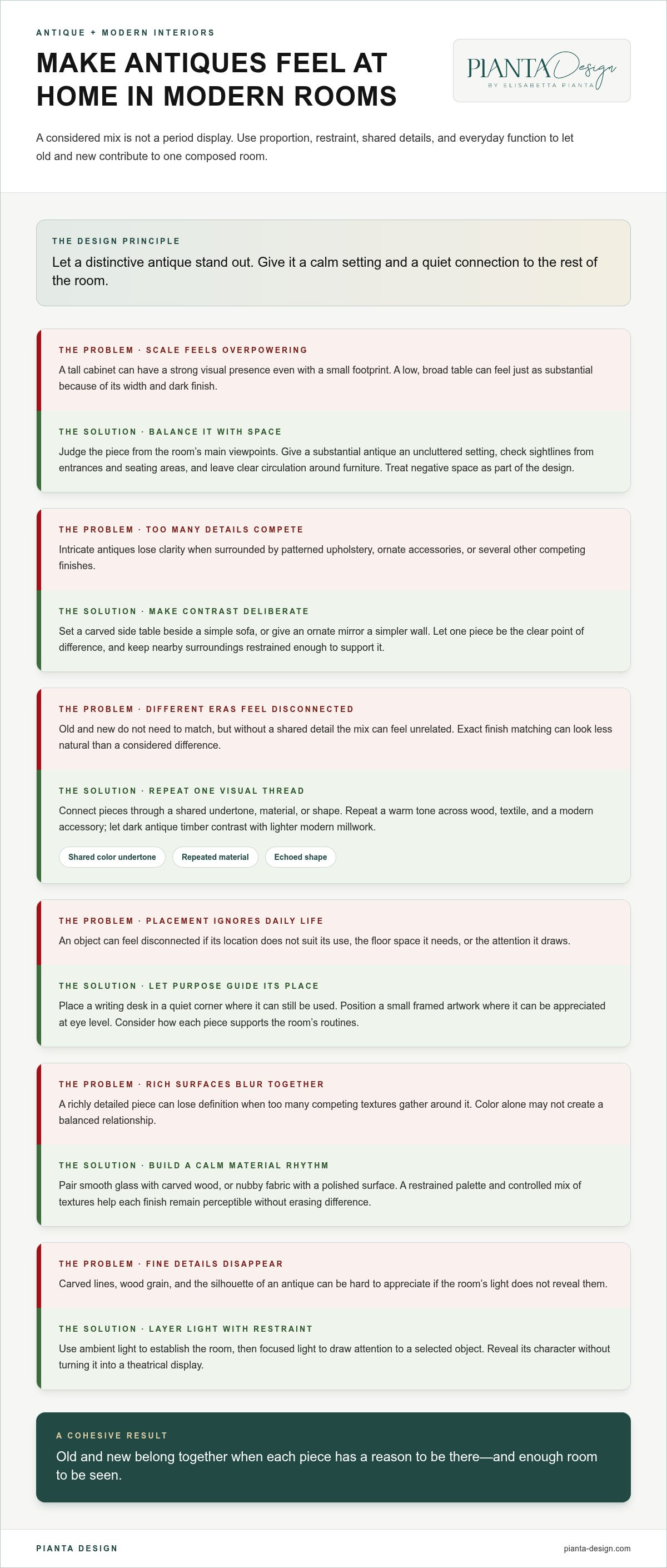
A Step-by-Step Method for Placing Antiques in a Modern Home
A deliberate sequence helps turn an admired antique into part of a comfortable, cohesive room. Before moving furniture or adding accessories, take stock of how the space is used and what already draws the eye. Then make choices in stages, so the piece’s character informs the arrangement without dictating every detail.
Place an antique with intention: understand its story, assess the room, build a supportive composition, then edit and review how the space feels.
- Identify what matters about the piece. Note what draws you to it: perhaps its craftsmanship, a family connection, its shape, or the way its surface has aged. Decide whether it should be a focal point, a practical furnishing, or a quieter accent. This role gives you a useful basis for later decisions.
- Read the room before choosing a spot. Consider the room’s function, architecture, palette, and existing furnishings. Notice established visual anchors such as a fireplace, large window, prominent artwork, or substantial sofa. Measure the antique and compare its height, width, and visual weight with nearby walls and furniture. Check that doors open, pathways remain clear, and people can use the room comfortably.
- Test placement in context. Try the antique where it can serve its intended role, then view it from the entrance, main seating area, and other important sightlines. A cabinet may feel balanced against a long wall but crowd a narrow passage; a small table may be more useful beside a chair than centered in an open area. Leave breathing room around the piece rather than filling every nearby surface.
- Choose contemporary elements that support it. Select furnishings and finishes that respond to the antique through proportion, material, color, or a related shape, without copying its period details. Consider how existing art, lighting, and accessories affect the composition. If the antique has a richly patterned surface, quieter textiles may help preserve visual clarity. If its form is simple, a textured contemporary material can add contrast.
- Edit and review before adding more. Step back from the arrangement and notice where your attention settles. Look for competing accents, awkward gaps, or objects that interrupt circulation. Remove or reposition elements that make the composition feel busy before introducing anything new. Live with the arrangement through ordinary routines, then refine it in response to how the room functions as well as how it looks.
This method keeps integrating antiques into a modern design responsive to the people who live there, rather than to a fixed formula. A home shaped around its residents considers daily habits alongside furniture, art, and architecture, a broader perspective explored in the art of residential interior design.
For a considered plan that connects a meaningful antique with contemporary furnishings and the way you use your home, learn more about personalized residential interior design.
Creating a Cohesive Antique-Modern Home with Pianta Design
A treasured antique is easiest to integrate when it’s considered as part of the home’s wider design, not as a finishing touch added after the room is complete. Pianta Design’s personalized residential interior design brings concept development, space planning, finishes, furnishings, and art into one considered vision. This approach helps establish how a meaningful piece can relate to the architecture and contemporary elements while keeping the home personal rather than shaped by a preset style.
Bring one design vision from concept through installation
Pianta Design coordinates the design process from concept through installation through a single-team, single-vision approach. Space planning can account for an antique’s dimensions, function, and visual presence early, alongside circulation, architectural features, and the placement of new furnishings. As the project develops, the studio collaborates with architects, builders, and contractors, helping connect the interior vision with the work taking place across the home.
This continuity matters when an antique affects more than one decision. A substantial heirloom might influence a room’s layout, the scale of nearby seating, the selection of finishes, and where artwork or lighting belongs. Fine art and decorative accessories, contemporary furnishings, and FF&E procurement can all be considered in relation to that piece, so the room reads as a complete composition rather than a series of separate choices.
Shape the home around the people who live in it
The right design response depends on why an object matters and how its owners want to live. An antique desk used every day calls for a different setting from a decorative piece or a family heirloom displayed for its history. Pianta Design connects those preferences with the practical needs of the room, allowing the antique to have a meaningful role without asking the rest of the interior to imitate its era.
Where standard furnishings don’t relate well to a distinctive piece or the room’s proportions, tailor-made furniture and integrated millwork can support the overall composition. Material and finish choices can carry a subtle connection across old and new, while art selection can help the home express its residents’ interests. Led by architect Elisabetta Pianta, the studio brings over 30 years of international experience to these layered design decisions.
Take the next step with a personalized design conversation
Integrating antiques into a modern design is a personal process, shaped by the character of each object and the rhythms of daily life. Pianta Design works with clients in Park City, San Francisco, and Miami, as well as on domestic and international projects. A design conversation can begin with the piece that matters most, the rooms it might inhabit, and the atmosphere you want your home to hold. Pianta Design’s transparent monthly flat-fee basis supports a clear design process from concept through installation.
Explore residential interior design with Pianta Design.
Let a Meaningful Piece Shape What Comes Next
The next step doesn’t have to be a complete redesign. Begin with the antique that matters most, and consider what you want it to bring into your home: a sense of memory, a touch of warmth, or a distinctive note that feels unmistakably yours. From there, imagine how the rooms around it could support the way you live, with enough space for both the object’s history and the comforts of the present.
That perspective makes integrating antiques into a modern design less about following a style formula and more about creating a home with personal meaning. The most considered interiors leave room for stories to evolve, allowing treasured pieces and new choices to feel connected without losing their individuality.
Ready to explore how a meaningful antique might inform a larger vision for your home? Start a residential interior design conversation with Pianta Design.
Frequently Asked Questions
Can antiques work in a minimalist modern room?
Yes, integrating antiques into a modern design can work beautifully in a minimalist room when one piece is treated as a deliberate exception rather than the start of a display. A small ceramic vessel on a spare console, for instance, can introduce age without adding visual noise. Remove nearby accessories and view the arrangement in daylight and evening light. If the room still feels calm and the object feels purposeful, the pairing is working.
How do I know whether an antique is the right size for a room?
Judge the antique by its footprint and perceived weight, not height alone. To preview it, use painter’s tape to mark its outline on the wall or floor, then check how much room remains for doors, chairs, and walking paths. Compare its top edge with nearby furniture and architectural lines, too. If the object interrupts movement or dominates every view, consider another placement or a smaller piece.
What colors pair well with dark antique wood?
Dark antique wood can work with light, muted, or deeper colors; the room’s natural light and surrounding finishes help determine the right direction. In a shaded room, a lighter wall or textile can make the wood’s outline easier to read. For a more enveloping mood, related warm tones can sit alongside it. Look at samples together in the room, since nearby stone, flooring, and upholstery can shift how a wood tone appears.
Should I restore an antique before using it in a modern interior?
Not necessarily; restoration depends on the piece’s intended use and what you value in its present appearance. If a worn surface carries the character you love, preserving that appearance may suit the room better than making the object look new. If you plan to use it regularly, consider whether its current condition supports that function. Make the decision piece by piece, rather than assuming age marks always need to be removed.
Can I mix antiques from different periods in one room?
Yes, antiques from different periods can share a room if the arrangement has a clear point of connection. Instead of organizing them by age, consider whether their shapes, materials, or visual weight relate to one another. For example, a pair of pieces with curved profiles may feel connected even if their finishes differ. Distribute them with intention so the room feels composed, rather than like a collection gathered in one corner.
How can I display antique art with contemporary artwork?
Start by arranging the works on the floor or using paper templates on the wall before hanging anything. This lets you compare overall scale, spacing, frame depth, and color relationships without committing to a layout. A shared visual note, such as a repeated tone or a strong contrast, can help the grouping feel considered. Check the arrangement from the room’s main seating position, not only from directly in front of the wall.
