
The most significant risk in a high-end renovation isn't the selection of a rare stone or a hand-knotted silk rug; it's the failure to view your residence as a generational capital investment. For many, the true luxury interior design cost remains shrouded in mystery, hidden behind opaque pricing structures and the persistent fear of uncontrolled budget expansion. You likely recognize that creating a home of distinction requires more than just capital. It demands a precise alignment of artistry and financial clarity.
We understand that the transition from a conceptual vision to a finished masterpiece can feel daunting when the path to procurement is unclear. This 2026 investment guide removes the veil, offering a transparent breakdown of professional fees, sourcing logistics, and the tangible ROI of expert project management. You'll discover how bespoke Italian sourcing and a refined architectural approach can actually protect your equity. We will explore the framework for a predictable budget, the hidden value of trade pricing, and why the harmony of your environment is the ultimate measure of a project's success.
Key Takeaways
- Understand how a firm’s decades of tenure and focus on interior architecture mitigate financial risks during complex, high-end renovations.
- Decode the nuances of hourly and flat fee structures to better anticipate the total luxury interior design cost for your 2026 investment.
- Identify regional cost drivers across San Francisco, Miami, and Park City to ensure your budget reflects local market realities and specialized design requirements.
- Master the "Percentage of Home Value" rule to create a balanced allocation between professional design services, bespoke furnishings, and technical oversight.
- Learn how an integrated philosophy combining custom furniture design with Italian sourcing elevates your home from a mere residence to a legacy asset.
What Defines the Cost of Luxury Interior Design?
True luxury is never accidental. It's the result of a deliberate, highly technical process that transforms a physical structure into a personalized sanctuary. When we discuss the luxury interior design cost, we aren't merely looking at the price of furniture. We're examining the value of a multifaceted profession that harmonizes structural constraints with human emotion. Luxury interior design is the seamless fusion of bespoke artistry and technical precision.
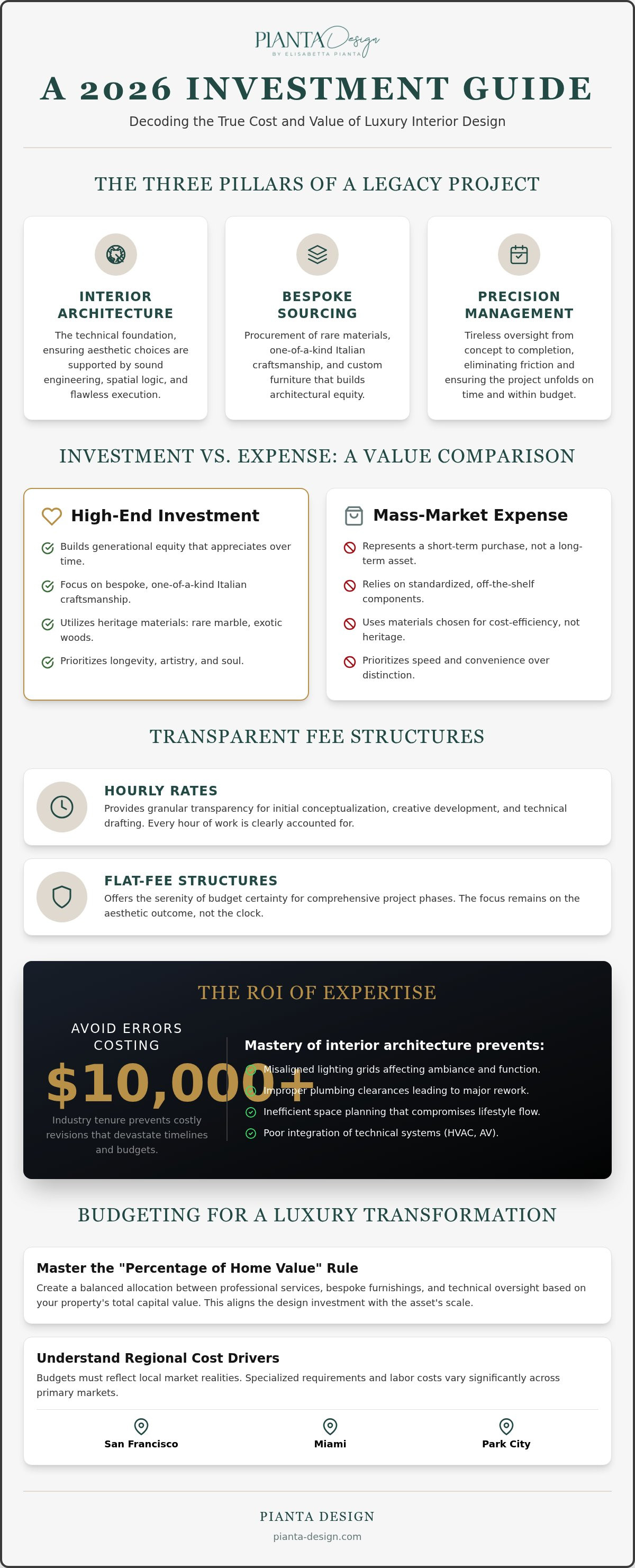
An investment of this magnitude rests on three core components: professional design fees, the procurement of rare materials, and the tireless precision of project management. These elements work in concert to eliminate the friction typically found in standard renovations. By engaging a firm with 30 years of industry tenure, you're effectively purchasing a policy against uncertainty. This depth of experience allows designers to visualize the finished space before the first wall is moved, preventing the costly revisions that often plague less experienced teams.
The Difference Between High-End and Mass-Market Design
The distinction between mass-market solutions and premium environments is found in the DNA of the materials used. Mass-market design relies on standardized, off-the-shelf components that prioritize speed over soul. Conversely, high-caliber residential interior design focuses on one-of-a-kind Italian craftsmanship and heritage materials. Whether it's a slab of rare Calacatta marble or hand-finished exotic woods, these choices impact the luxury interior design cost because they offer longevity. They don't just fill a room; they build architectural equity that appreciates over time.
Why Expertise Commands a Premium
Technical proficiency is the most valuable asset a designer brings to the table. A mastery of interior architecture ensures that every aesthetic choice is supported by sound engineering and spatial logic. This level of insight prevents $10,000+ errors in space planning, such as misaligned lighting grids or improper plumbing clearances, which are devastating to both the timeline and the budget. Beyond technical skill, an established firm provides exclusive access to a global network of artisans and contractors. These relationships ensure that your project receives the highest tier of craftsmanship, which is often inaccessible to the general market.
Understanding Fee Structures: Hourly, Flat, and Procurement
Clarity in financial planning is the cornerstone of a successful partnership. When navigating the luxury interior design cost, you'll encounter several distinct billing models designed to align with project complexity. Hourly rates often serve as the standard for initial conceptualization and technical drafting. This model provides granular transparency, ensuring that every hour of creative energy is accounted for. However, modern luxury firms are increasingly moving toward flat-fee structures for comprehensive project phases. This approach offers the serenity of budget certainty. It allows the focus to remain on the aesthetic outcome rather than the ticking clock.
Technical planning fees are a critical investment in the longevity of your home. They cover the intensive labor behind 3D visualizations and detailed floor plans. These aren't mere drawings; they're the technical blueprint for your lifestyle legacy. They ensure that custom millwork and lighting schemes are mathematically perfect before any physical work begins, saving you from costly field corrections.
Transparent Billing Models for High-Net-Worth Projects
Luxury firms typically manage the rhythm of a project through structured retainers and progress payments. This ensures that the momentum never falters. It's vital to distinguish between design time and material costs. For instance, the investment in custom furniture design involves both the creative fee and the manufacturer's production costs. Transparent billing models clearly delineate these categories. This prevents the confusion between procurement costs and professional service fees that often impacts the overall luxury interior design cost and leads to unnecessary budget anxiety.
The Value of Sourcing Authentic Italian Craftsmanship
Italian manufacturing remains the undisputed gold standard for premium interiors. The procurement process is a sophisticated logistical dance. It begins on a factory floor in Italy and ends with white-glove delivery in your residence. Leading interior design firms leverage exclusive trade-only pricing to secure these pieces. While many firms apply a procurement commission to manage shipping and customs, some offer a transparent monthly flat-fee that includes procurement oversight. This ensures you benefit from the designer's professional network and trade discounts without hidden markups. If you're seeking a partner to manage these complex logistics, exploring how premier design services can streamline your project is an essential first step.
Regional Variations: San Francisco, Miami, and Park City Markets
Geography dictates the technical requirements of a space, which directly influences the luxury interior design cost. In San Francisco, the market is defined by a sophisticated tension between historic preservation and modern sensibility. Renovating a heritage property in Pacific Heights requires a designer who understands both the structural integrity of Edwardian architecture and the integration of ultra-modern Italian cabinetry. These projects often involve complex permit processes and specialized labor, driving the investment higher than standard modern builds.
Across the country, the Miami market presents a different set of challenges. While residential projects remain a staple, the region's focus on luxury yacht interior design introduces unique cost drivers. Marine environments demand specialized engineering and materials that can withstand corrosive salt air while maintaining a five-star aesthetic. Whether on land or at sea, the logistics of coastal freight and white-glove delivery through high-traffic corridors add layers of complexity to the final invoice.
Coastal vs. Mountain Luxury: Logistics and Material Costs
The environmental factors of a location necessitate specific material choices. In Park City, designers must account for intense UV radiation and extreme temperature fluctuations. This requires high-performance textiles and timber treatments that prevent fading and warping. Furthermore, the 2026 Wildland Urban Interface codes in Utah have introduced new technical requirements for exterior and interior transitions, impacting both design and material selection. Logistics also play a role; the "mountain tax" refers to the increased shipping costs and seasonal delivery windows associated with high-altitude locations. In contrast, Miami projects prioritize humidity control and moisture-wicking materials to ensure the longevity of bespoke furnishings.
Project Tiers: Residential, Commercial, and Yacht
Each project tier carries its own financial logic. Residential design is often the most detail-intensive, requiring a deeply personal approach to space planning and art consultation. Commercial luxury projects, however, focus on high-traffic durability without sacrificing elegance. These spaces must meet stringent safety codes while reflecting a brand's premium identity. Yacht interiors represent the pinnacle of technical design, where every millimeter of space is engineered for stability and weight distribution. This level of marine-grade precision naturally impacts the luxury interior design cost, as it requires artisans who are as skilled in naval architecture as they are in aesthetic composition.
How to Budget for Your Luxury Transformation
Creating a realistic framework for your luxury interior design cost requires a shift in perspective. Instead of viewing the budget as a series of disconnected expenses, consider it a holistic investment in your property's architectural equity. A recognized benchmark for full-home luxury transformations is to allocate between 25% and 50% of the home’s current market value. This ensures the interior quality matches the structural prestige. When you invest at this level, you aren't just decorating; you're curated a lifestyle legacy that will endure for decades.
Strategic allocation is the key to maintaining financial harmony. Your funds should be divided into three primary categories: professional design fees, procurement of furnishings, and technical oversight. While it's tempting to focus solely on the visible elements, a 10-15% contingency fund is essential for bespoke projects. This buffer protects the integrity of the design during the fluid process of creation, accounting for the meticulous refinements that often occur when working with one-of-a-kind Italian materials or complex site conditions.
Consider a sample budget breakdown for a primary suite renovation. The investment typically distributes as follows: 20% for interior architecture and specialized lighting design, 55% for bespoke furnishings and imported textiles, 10% for technical project management, and 15% reserved for contingencies. This balanced approach ensures that the technical foundation is as strong as the aesthetic finish.
Estimating Room-by-Room Investment Tiers
Not all rooms require the same level of financial intensity. The kitchen and primary suite are the emotional and financial anchors of a home, typically offering the highest ROI. These spaces demand the most complex interior architecture and high-performance materials. Common areas should prioritize statement lighting and custom millwork to create a cohesive narrative throughout the home. Many homeowners now extend this vision to the landscape, engaging an interior designer to ensure a seamless transition between indoor and outdoor luxury environments.
Hidden Costs: Project Management and Site Visits
Technical project management is often viewed as a "hidden" cost, but it's actually a cost-saving insurance policy. Professional oversight prevents the expensive errors that occur when contractors misinterpret complex design documents. For multi-state projects, such as a primary residence in San Francisco and a seasonal retreat in Park City, the logistics of site visits and administrative coordination are vital. This includes the administrative labor of art consultation and final styling, which are the finishing touches that elevate a house into a home. To begin your journey with a partner who prioritizes financial transparency, schedule a consultation with Pianta Design today.
The Pianta Design Philosophy: Investing in Timeless Sophistication
The Pianta Design philosophy is rooted in the belief that a home should be a reflection of an individual’s journey, captured through the lens of timeless sophistication. We balance modern innovation with a deep respect for classical elegance, ensuring that every space remains relevant for generations. This integrated approach is what defines our 30-year legacy. By managing the transition from interior architecture to custom furniture design in-house, we eliminate the inefficiencies that often inflate the luxury interior design cost for high-net-worth clients. We don't just decorate rooms; we curate environments where every finish and structural detail exists in perfect harmony.
Our methodology is inspired by the Italian principle of "From the Spoon to the City," which treats the smallest detail and the largest structure with equal importance. This holistic view ensures that the interior architecture supports the final styling, creating a cohesive narrative that flows through every room. When a single partner manages the entire lifecycle of a project, from the initial sketch to the final installation, the result is a level of precision that fragmented teams simply cannot replicate. This continuity is the ultimate safeguard for your investment, ensuring that the original vision is never compromised by logistical friction.
From Concept to Implementation: A Seamless Journey
The journey begins with a collaborative phase where mood boards and technical 3D visualizations serve as the project's north star. These tools aren't merely for aesthetic approval; they're precise instruments that allow us to refine the luxury interior design cost before procurement begins. Once the vision is set, we leverage our exclusive Italian manufacturer collaborations to source materials and furnishings that are unavailable to the general public. This procurement phase is a sophisticated logistical operation that bypasses retail markups while securing world-class craftsmanship. The process culminates in a white-glove installation and reveal, where our final quality control ensures that every element meets our rigorous standards of excellence.
Beginning Your Bespoke Design Partnership
Entering into a design partnership is a significant commitment to your future lifestyle. During an initial luxury consultation, we focus on understanding the "soul" of your project, whether it's a historic San Francisco estate, a modern Miami yacht, or a Park City retreat. We don't believe in rigid, one-size-fits-all pricing. Instead, we tailor our fee structures to the unique scope and technical complexity of your property. Our transparent monthly flat-fee model is designed to provide you with peace of mind, allowing you to focus on the creative evolution of your home. Taking the first step toward an elevated lifestyle means choosing a partner who values your time and your legacy as much as you do. We invite you to experience a design process where technical mastery and artistic passion converge.
Cultivating Your Legacy Through Architectural Harmony
Understanding the true luxury interior design cost is about recognizing the value of technical precision and artistic vision. We've explored how a strategic budget balances professional fees with the procurement of rare materials, ensuring your estate or yacht becomes a timeless asset. Whether you're navigating the historic requirements of San Francisco or the marine engineering of Miami, the right partnership protects your equity from the risks of fragmented planning. It's a capital investment in your lifestyle and your property's future value.
Pianta Design brings over 30 years of high-end design expertise to every project. We offer full-service management across major luxury hubs and provide exclusive access to Italian manufacturers, ensuring your home reflects a standard of craftsmanship that's truly world-class. It's time to transform your vision into a finished masterpiece with a partner who values your legacy as much as you do. We look forward to creating a space that resonates with your unique sense of harmony and order.
Schedule Your Luxury Design Consultation with Pianta Design and begin the journey toward an elevated lifestyle today.
Frequently Asked Questions
How much does a luxury interior designer cost per hour in 2026?
In 2026, luxury interior design rates reflect the expertise and regional demand of the market. In San Francisco, hourly fees typically range from $150 to $300, while Miami rates align between $100 and $300 per hour. Park City offers a broader spectrum, with professionals billing between $50 and $200. These rates compensate for technical drafting and conceptual work, though many premier firms are transitioning toward transparent flat-fee models to provide clients with greater budget predictability.
Is it cheaper to buy furniture myself or use a designer?
While purchasing furniture directly may seem cost-effective, using a professional designer often yields higher value through exclusive trade-only access. Designers leverage relationships with Italian manufacturers to secure pieces that aren't available to the general public. These items are built for longevity and architectural harmony, whereas retail options often carry hidden markups and lack the bespoke quality required for high-end estates. A designer's procurement oversight also prevents expensive logistical errors and shipping delays.
What is the average cost to furnish a luxury primary bedroom?
Furnishing a luxury primary bedroom is a significant component of the overall luxury interior design cost. In markets like Miami, a single-room project typically ranges from $15,000 to $50,000, depending on the level of customization and material selection. For estates valued over $5 million, furnishings generally represent 8% to 15% of the total build cost. This investment covers bespoke cabinetry, hand-finished textiles, and statement lighting that elevates the space into a private sanctuary.
Why do luxury designers charge a procurement commission?
Procurement commissions cover the complex logistics of bringing one-of-a-kind items into your home. This fee manages the entire lifecycle of a purchase, from factory-floor coordination in Italy to white-glove delivery and installation. It accounts for the administrative labor of tracking international shipments, handling customs documentation, and performing rigorous quality control upon arrival. By managing these details, the designer ensures that every piece arrives in pristine condition and fits perfectly within the intended architectural scheme.
How does the location (e.g., San Francisco vs. Miami) affect design costs?
Location significantly influences the technical requirements and logistical expenses of a project. San Francisco projects often focus on historic preservation, requiring specialized labor and permits. In contrast, Park City involves shipping costs and compliance with 2026 Wildland Urban Interface codes. Miami projects must prioritize humidity-resistant materials and coastal freight logistics. These regional nuances dictate the selection of high-performance materials and the intensity of technical oversight required to ensure the project's longevity.
What is the typical design fee for a luxury yacht refit?
Design fees for a luxury yacht refit are determined by the specialized engineering and marine-grade materials required for life at sea. Unlike residential projects, yacht interiors must account for weight distribution, stability, and corrosive salt air. The technical proficiency needed to navigate these constraints is reflected in the fee structure. These projects often require a higher level of coordination with naval architects and specialized contractors to ensure that every aesthetic choice meets maritime safety standards.
Does hiring an interior designer increase my home’s resale value?
Professional interior design is a strategic investment that builds architectural equity and enhances resale value. Homes with a cohesive, professionally executed design narrative often command higher market prices and attract more discerning buyers. By integrating high-quality materials like rare stone and bespoke Italian furniture, you create a legacy asset that transcends temporary trends. This level of detail suggests a well-maintained property, giving potential buyers confidence in the home's overall structural and aesthetic integrity.
What is included in a luxury project management fee?
A luxury project management fee covers the technical oversight necessary to transform a concept into a physical reality. This includes coordinating with contractors, conducting regular site visits, and ensuring that all work adheres to the technical drafting and space planning documents. It acts as a cost-saving measure by preventing expensive errors in construction and installation. The fee also encompasses the administrative labor of art consultation, final styling, and the meticulous coordination of all project phases.
