
Signs of a Bad Luxury Interior Designer: How to Protect Your Investment
What if the most expensive mistake in your new estate isn't the rare marble or the custom millwork, but the person you've entrusted to manage it all? Recognizing the signs of a bad luxury interior designer early is the only way to protect a project that should be a seamless extension of your success. It's natural to feel a tightening sense of anxiety when communication becomes opaque or when those "bespoke" solutions start looking suspiciously like a catalog showroom. You expect a home that serves as a personal legacy, not a stressful exercise in contractor mismanagement and spiraling timelines.
This guide empowers you to vet your creative partners with the scrutiny your investment deserves. We'll provide the clarity you need to spot incompetence before it compromises your home, yacht, or commercial space. We'll examine the critical red flags of poor project management, from a lack of procurement transparency to the inability to handle 2026's complex global lead times. By the end, you'll know exactly how to ensure your design experience remains a sophisticated, concierge-level journey from the first sketch to the final installation.
Key Takeaways
- Identify why a designer who waits for your cues rather than leading with a proactive, concierge-level vision is a major warning sign for your project's success.
- Understand the critical difference between mere decorating and true interior architecture to ensure your space feels as balanced as it looks.
- Learn to spot the signs of a bad luxury interior designer through opaque procurement processes and a lack of direct access to elite artisan networks.
- Discover why consistent on-site oversight is non-negotiable for preventing contractor improvisations that compromise your design's integrity.
- Gain the criteria to select a partner whose professional longevity and transparent management style protect both your capital and your peace of mind.
The Red Flags of Communication: Why Silence is a Warning Sign
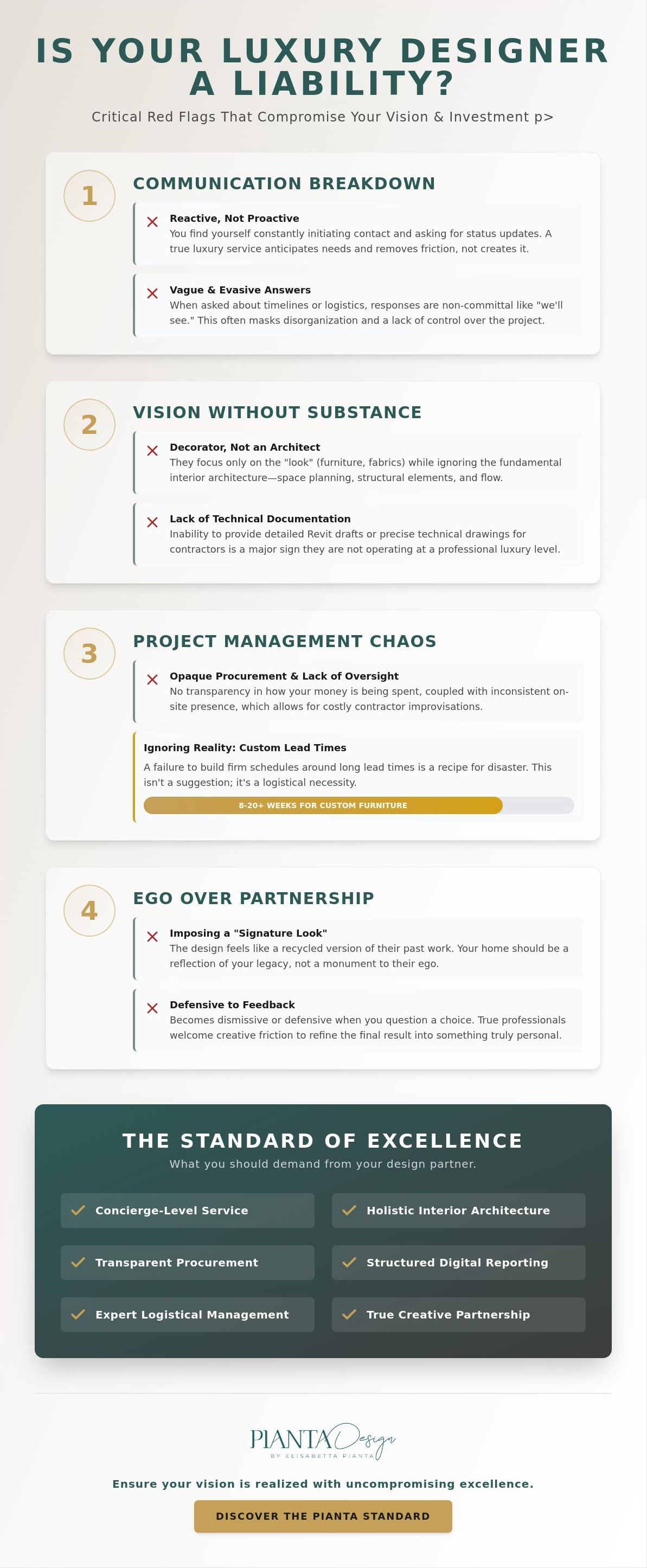
In the upper echelons of design, communication isn't just about answering emails; it's about anticipation. A true professional operates with a concierge mindset, moving three steps ahead of the client's needs. If you find yourself constantly initiating contact or asking for status updates, you've encountered one of the most persistent signs of a bad luxury interior designer. Luxury is, by definition, the removal of friction. When a designer waits for your prompts, they aren't leading; they're reacting. This passivity often masks a lack of organization or, worse, a lack of commitment to your project's specific rhythm.
Watch closely during the initial conceptual phases. If the mood boards and material samples feel like a recycled version of the designer's previous work, they've stopped listening. Your home should be a reflection of your personal legacy, not a monument to a designer's "signature look." A professional who prioritizes their ego over your lifestyle is failing the fundamental test of bespoke service. They should be interpreting your unspoken needs, not imposing their aesthetic preferences. When the dialogue becomes one-sided, the soul of the project is the first thing to disappear.
The Difference Between a Decorator and a Design Partner
True excellence requires a partner who views residential interior design as a holistic, high-stakes service. A "yes-man" who agrees with every suggestion lacks the professional confidence to guide you away from costly aesthetic mistakes. You aren't paying for an echo; you're paying for an expert who adheres to the ASID code of ethics, ensuring every decision is made with integrity and technical foresight. In 2026, this partnership must be supported by structured digital tracking and weekly reporting. Ambiguity is the enemy of investment. If a designer responds to questions about delivery with "we'll see how it goes," they're ignoring the reality of modern logistics. With custom furniture lead times often stretching between 8 and 20 weeks, a lack of firm scheduling is a recipe for disaster.
Feedback Loops and Creative Friction
A healthy design process thrives on constructive disagreement. If your designer becomes defensive when you question a choice, it's a sign they're overwhelmed by the scale of the project. True masters of the craft welcome creative friction because they know it refines the final result. They don't see your feedback as an obstacle, but as the essential raw material for a more personalized outcome. The Luxury Communication Standard is a proactive, transparent, and multi-channel dialogue. It ensures that every stakeholder, from the architect to the client, is aligned with the vision at every stage of the journey.
Technical Incompetence: When Vision Doesn’t Match Architectural Reality
Technical mastery is the invisible foundation of any successful luxury interior. If a designer can't navigate the complexities of load-bearing walls or HVAC integration, the most beautiful furniture in the world won't save the project. One of the most telling signs of a bad luxury interior designer is an obsession with the "look" of a room while ignoring its fundamental interior architecture. Elite professionals don't just decorate; they sculpt the space itself, ensuring that every proportion and structural element serves a purpose. Identifying the signs of a bad luxury interior designer often begins with the quality of their documentation; if they can't provide detailed Revit drafts or precise technical drawings for your contractors, they aren't operating at a luxury level.
Space planning is where many amateur designers falter. A room that looks stunning in a rendering but feels cramped or awkward in practice is a technical failure. Effective space planning requires a deep understanding of human ergonomics and the specific flow of your daily life. Similarly, failing to integrate lighting design into the initial architectural drafts is a hallmark of incompetence. Lighting shouldn't be an afterthought added once the walls are up. It must be engineered into the fabric of the building to evoke the correct mood and functionality, from the subtle glow of cove lighting to the precise placement of gallery spots.
The Trap of the "Instagrammable" Room
Social media has created a surge in "fast-design" that prioritizes visual impact over longevity. According to a 2026 industry survey, only 27% of designs found on social media are actually feasible to implement in a high-end environment. A bad designer will chase these fleeting trends, sourcing exclusively from retail catalogs instead of custom manufacturers. This leads to spaces that lack soul and require expensive corrections when the "cool" factor fades or the furniture fails to handle daily use. For those seeking a truly bespoke environment, professional interior architecture provides a timeless alternative to these temporary, surface-level trends.
Material and Finish Missteps
Technical incompetence also manifests in poor material selection. A designer must understand how local climates, such as Miami's humidity or the dry cold of Park City, affect specific stones, woods, and textiles. If they can't explain the provenance of a material or why it's technically suited for its specific environment, they're gambling with your investment. If these technical oversights lead to disputes, you'll realize too late the necessity of a formal complaints procedure. Elite firms leave nothing to chance, providing the technical oversight required to protect the project's integrity from inception to completion.
The Business of Luxury: Procurement and Transparency Pitfalls
The true measure of a luxury firm lies in the invisible architecture of its supply chain. While aesthetics capture the imagination, the mechanics of procurement protect the investment. One of the most glaring signs of a bad luxury interior designer is a lack of transparency regarding sourcing and commissions. In high-end design, markups on furnishings typically range from 20% to 60%, but these should never be a "black box" mystery. A professional partner provides clear disclosure, ensuring you aren't overpaying for mediocrity disguised as exclusivity. When a designer resists showing material origins or physical samples, they're likely hiding a lack of direct manufacturer relationships.
Many practitioners fall into the trap of being "catalog designers." They act as expensive middlemen for high-end retail stores that any consumer could theoretically access. A genuine luxury firm, however, offers a gateway to a world of restricted access; specifically, deep-rooted partnerships with Italian manufacturers and bespoke artisans. If your designer's portfolio looks like a curated showroom for a single brand, it's a warning sign. They should be orchestrating a unique symphony of textures and forms, not just placing orders from a digital PDF. Poor logistics management can stall a multi-million dollar build for months. With lead times for custom pieces often reaching 20 weeks, you need a designer who manages the timeline with surgical precision.
Sourcing Authentic Craftsmanship
Investing in custom furniture design is the hallmark of a legacy home. It elevates a space beyond the reach of mass-produced luxury labels. You should be able to verify the provenance of every stone slab and hand-woven textile. A bad designer will often offer vague reassurances about "Italian-made" quality without being able to name the specific workshop or the artisans involved. This lack of detail is one of the subtle signs of a bad luxury interior designer. Authenticity requires a paper trail and a designer who isn't afraid to let you see the craftsmanship behind the curtain.
Financial Clarity in High-End Projects
A professional fee structure should be as elegant as the design itself. Expect a clear distinction between conceptual fees and project management fees. Be wary of requests for large lump sums that aren't tied to a detailed procurement schedule. This financial ambiguity often leads to friction. When tensions arise, a competent professional knows how to resolve client disputes through structured dialogue and documentation rather than evasion. Finally, remember that a bespoke environment is incomplete without a thoughtful art consultation. A designer who ignores the cultural and financial value of a private art collection is missing a vital component of the luxury lifestyle.
Project Management Failures: When the Vision Falls Apart on Site
The most exquisite rendering remains a fragile dream until it's anchored by rigorous project management. One of the most destructive signs of a bad luxury interior designer is a lack of physical presence on the construction site. When a designer is absent, contractors are forced to improvise, often compromising the delicate alignment of custom millwork or the precise placement of floor-recessed lighting. A professional doesn't just hand over a set of drawings; they act as the steward of the vision, ensuring every trade professional understands the nuance of the aesthetic. If your designer creates friction with the build team rather than fostering collaboration, the project's integrity is at risk.
Ignoring local building codes and environmental regulations is another catastrophic failure that marks an amateur. In 2026, navigating the updated scope of practice for designers in Utah or the proposed licensing regulations in California requires more than just good taste. A designer unfamiliar with the specific requirements for mountain builds in Park City or the stringent waterproofing standards for waterfront estates and interior design firms in Miami is a liability. Setbacks are inevitable in complex builds, but a bad designer treats these as "not my problem," leaving the owner to mediate between disgruntled contractors and delayed suppliers. They should be the shield that protects you from the chaos of the site, not another source of it.
The Designer-Architect Relationship
The best designers act as a technical bridge. They must speak the language of architects and engineers fluently to ensure that interior architecture and structural requirements are in perfect harmony. If your designer seems confused by architectural drafts or fails to coordinate early in the process, it's a warning sign. This is especially critical in specialized environments like yacht interior design, where every millimeter is governed by maritime engineering and weight distribution. A failure to respect these technical boundaries can lead to costly retrofits and safety compromises.
Logistics and Quality Control
True luxury service is defined by how a firm handles the unexpected. If a hand-carved marble basin arrives with a hairline fracture, a bad designer might hide the flaw or blame the carrier without offering a solution. An elite partner takes immediate ownership, initiating a white-glove replacement process before you even notice the issue. They manage the final installation phase with a level of care that borders on the obsessive, ensuring that every piece of custom furniture is placed with surgical precision. Project Stewardship is the designer’s commitment to the final inch of execution, ensuring the reality matches the promise. For a project managed with this level of technical rigor, contact the experts at Pianta Design today.
The Pianta Standard: Choosing Excellence for Your Legacy
Protecting your investment requires more than just avoiding the signs of a bad luxury interior designer; it demands the selection of a partner who views your project as a future legacy. At Pianta Design, we replace the anxiety of mismanagement with the assurance of absolute precision. Our approach is defined by a commitment to harmony, where the aesthetic vision is never compromised by technical limitations. We believe that a home, yacht, or commercial space should be an evocative environment that reflects the occupant's highest aspirations. This level of environmental quality has a direct, profound impact on the standard of daily life.
Our global perspective allows us to source the finest materials directly from Italian manufacturers, bringing an authentic sense of provenance to projects in Miami, Park City, and San Francisco. This international reach is balanced by deep local expertise, ensuring that every design respects its architectural context and environmental requirements. From the initial 3D visualization to the final, meticulous placement of a curated art collection, we provide a comprehensive project management experience that is entirely seamless. We don't just decorate spaces; we orchestrate entire lifestyles through thoughtful interior architecture and bespoke curation.
Why 30+ Years of Experience Matters
Longevity in the luxury market is the ultimate proof of professional competence. Under the leadership of Maria Pianta, our firm has spent three decades refining the art of the bespoke. This experience allows us to navigate the complexities of simultaneous high-stakes projects, whether it's a sprawling mountain estate or a custom yacht interior. We don't just design for the present moment; we create spaces that increase in both aesthetic and financial value over time. Our clients trust us because we've proven, time and again, that we can translate the most ambitious concepts into tangible reality without the friction typical of less experienced firms. This depth of knowledge ensures that even the most subtle signs of a bad luxury interior designer are absent from our process.
Your Next Steps to an Elite Interior
Before committing to a partnership, it's essential to conduct a thorough "Design Audit" during your initial consultation. Ask potential designers about their procurement transparency and their specific site oversight protocols. We encourage you to check references for projects of a similar scale and complexity to yours. A true professional will welcome this scrutiny as a sign of a discerning client. If you're ready to move beyond the common pitfalls of the industry and experience a concierge-level journey, we invite you to schedule a consultation with Pianta Design. Let's begin the process of creating a space that serves as your enduring legacy and a sanctuary of timeless sophistication.
Securing the Future of Your Bespoke Environment
Choosing a design partner is a profound decision that shapes both your daily experience and your property's long-term value. By identifying the signs of a bad luxury interior designer early, you safeguard your project from the high costs of technical errors and opaque procurement. True excellence isn't found in a catalog; it's forged through the synthesis of rigorous project management and world-class craftsmanship. You deserve a professional who acts as a dedicated steward of your vision, ensuring that every detail, from the structural bones to the final art placement, is executed with surgical precision.
At Pianta Design, we bring over 30 years of premier design experience to every commission. Our direct partnerships with elite Italian manufacturers and specialized expertise in residential, commercial, and yacht interiors ensure a result that is as technically sound as it is aesthetically transcendent. We invite you to step into a world where your peace of mind is as prioritized as the beauty of your surroundings. Begin your journey toward a masterfully designed space with Pianta Design and create an environment that stands as a testament to your personal legacy.
Frequently Asked Questions
What is the #1 red flag when interviewing a luxury interior designer?
The primary red flag is a lack of proactive, concierge-level communication. If you're the one constantly pushing for updates or clarity, the professional hierarchy is inverted. A master designer should anticipate your needs and provide structured dialogue before questions even arise. Silence is often a symptom of underlying organizational chaos or a lack of commitment to your project's unique requirements.
How much should a high-end designer charge for the initial planning phase?
Fees for the initial planning phase vary based on project scope and the designer’s experience level. High-end firms typically utilize either a sophisticated hourly rate or a fixed design fee for the conceptual stage. This phase should always result in tangible deliverables, such as preliminary space plans, mood boards, and a clear project roadmap. Transparency in these early financial structures is essential for a successful partnership.
Is it a bad sign if a designer only works with specific manufacturers?
Relying exclusively on a limited selection of manufacturers is often one of the signs of a bad luxury interior designer. This "catalog" approach suggests a lack of deep industry relationships and limits the bespoke nature of your home. A premier designer should offer access to a global network of artisans and Italian manufacturers, ensuring your space is a unique reflection of your legacy rather than a showroom for a single brand.
Can a bad interior designer actually decrease my home’s resale value?
Incompetent design can significantly harm resale value by introducing poor spatial flow or substandard materials. A room that feels awkward or uses finishes that don't suit the local climate becomes a liability during future property assessments. Luxury buyers look for timeless sophistication and technical integrity; if these are missing, the home may require expensive retrofits that detract from the overall investment.
What should I do if my designer is consistently over budget?
You should immediately request a comprehensive procurement audit and a detailed budget reconciliation. Consistent overages often stem from poor logistics management or a lack of transparency in sourcing. If the designer can't provide a clear paper trail for every expenditure, it's a sign that the project's financial stewardship has failed. Professional firms manage budgets with the same rigor they apply to aesthetics.
How often should a luxury interior designer visit the construction site?
A luxury designer must visit the construction site at every major milestone and maintain a consistent weekly presence. Without regular oversight, contractors are left to improvise on complex details like custom millwork or integrated lighting. These visits are the only way to ensure the architectural reality matches the original vision and that technical standards are upheld throughout the build phase.
What is the difference between a high-end decorator and a luxury interior designer?
The primary difference lies in the mastery of interior architecture and technical documentation. While a high-end decorator focuses on surface-level aesthetics like fabrics and furniture, a luxury interior designer sculpts the space itself. This includes space planning, lighting design, and coordinating with architects to ensure the building’s bones support the final aesthetic. Designers provide the technical drafts required for complex construction.
How do I verify a designer’s claims of using "exclusive" Italian manufacturers?
Request physical material samples and detailed provenance documentation for any "exclusive" claims. Legitimate partnerships with elite Italian workshops involve a transparent paper trail, from the workshop's location to the specific artisans involved. Identifying the signs of a bad luxury interior designer often involves noticing when a designer is vague about the origins of a stone or textile or resists showing you the craftsmanship behind the curtain.
