
Navigating Florida Yacht Interior Design Regulations: A 2026 Luxury Refit Guide

Could the sheer aesthetic beauty of your new velvet bulkheads actually be the reason your yacht is denied insurance or fails its next inspection? While the sun-drenched docks of Fort Lauderdale suggest a world of creative freedom, the reality of florida yacht interior design regulations is a delicate dance between state-level licensing and non-negotiable federal maritime safety. It's understandable to feel overwhelmed by the conflicting reports of Florida's recent legislative sessions and how they impact your vessel. You've likely heard whispers of deregulation, yet you know that at sea, the rules of the Florida Building Code matter far less than the stringent requirements of the U.S. Coast Guard.
This guide ensures your next refit is as technically sound as it is visually breathtaking. We'll explore the specific safety standards governing high-end materials, from the 2026 PFOS phase-out in fire suppression to the transition toward electronic signaling. By mastering these complex intersections of law and luxury, you'll secure a clear roadmap for a compliant refit. You'll gain the confidence to select materials that satisfy both your aesthetic vision and the most rigorous flag-state inspections, ensuring your sanctuary on the water remains a safe, insured, and timeless masterpiece.
Key Takeaways
- Understand the 2026 distinction between registered designers and decorators to ensure your project lead possesses the necessary legal and technical standing for a complex refit.
- Navigate the complex florida yacht interior design regulations by identifying where state law ends and the superior authority of the U.S. Coast Guard and IMO begins.
- Verify the fire-retardant and smoke-toxicity ratings of luxury textiles to prevent insurance denials and ensure your vessel passes every rigorous flag-state inspection.
- Discover how to balance sophisticated aesthetic elements with maritime-specific constraints such as spatial efficiency, weight distribution, and moisture resistance.
- Learn how a specialized approach to material selection merges elite international craftsmanship with non-negotiable safety standards for a seamless, high-end refit experience.
Florida Interior Design Licensure: The 2026 Regulatory Landscape
The legal framework governing the Interior design profession in Florida has undergone a profound evolution. Since the passing of the Occupational Freedom and Opportunity Act (HB 1193), the state has moved toward a model of voluntary certification for residential projects. While this shift suggests a lighter regulatory touch, it hasn't diminished the prestige or the necessity of professional oversight. In 2026, the Florida Board of Architecture and Interior Design remains the vital custodian of professional standards, overseeing the 20 hours of continuing education required for those who maintain their registered status. For the discerning yacht owner, understanding how these florida yacht interior design regulations interact with state law is the first step in ensuring a refit is both beautiful and legally sound.
Deregulation in a land-based residential context doesn't waive professional liability when you're 50 miles offshore. A yacht is a complex, high-stakes environment where the margin for error is nonexistent. While anyone can style a salon, only those with a deep understanding of technical maritime constraints can truly design one. The 2026 landscape empowers owners with more choice, yet it places a higher premium on the designer's individual integrity and their commitment to global safety standards.
Registered vs. Unregistered: What Yacht Owners Must Know
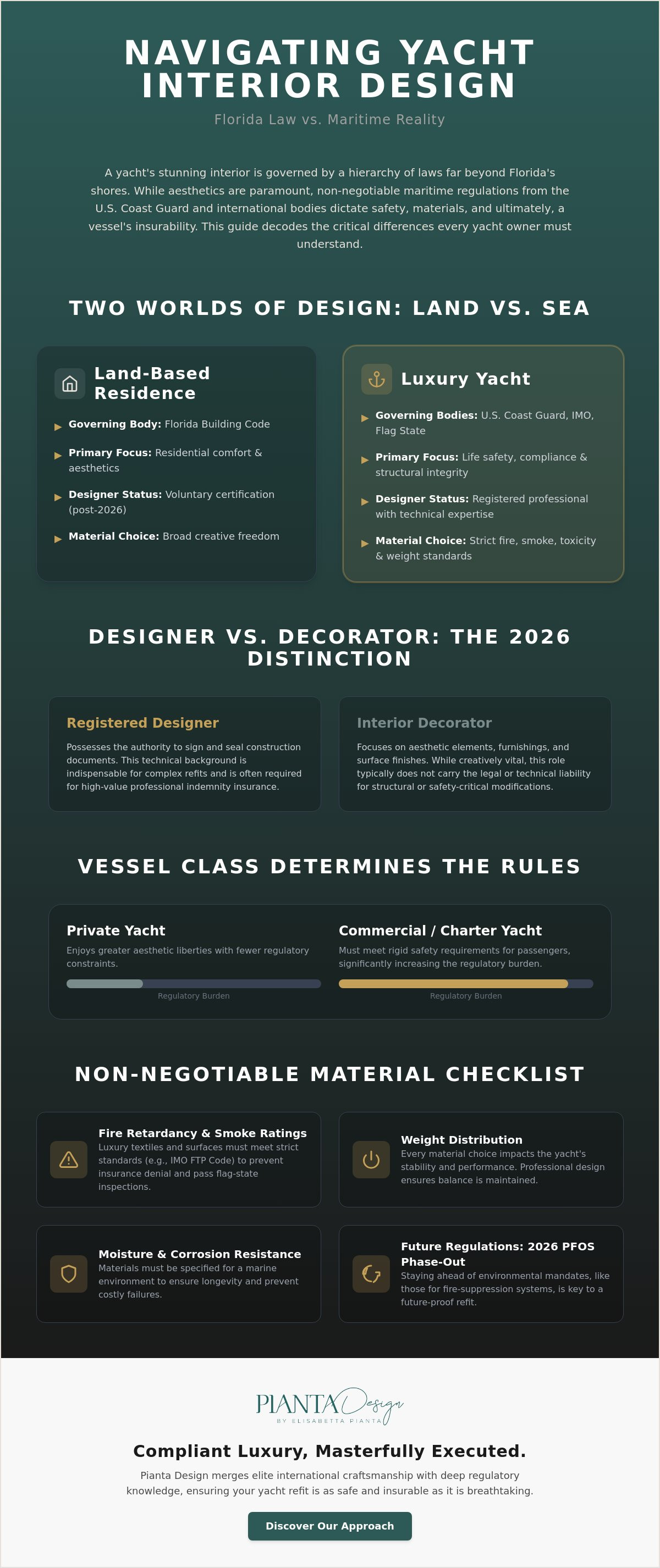
The distinction between a registered designer and an interior decorator often comes down to the weight of their signature. Registered designers in Florida possess the authority to sign and seal construction documents for commercial and multi-family structures. In the world of luxury yachting, this technical background is indispensable. It directly impacts professional indemnity insurance; many high-value policies require that a project's lead designer holds recognized credentials to mitigate the risk of material failure or non-compliance. When you're investing millions into a refit, the peace of mind provided by a designer who understands load-bearing structures and advanced fire codes is an essential luxury.
The Legal Freedom of the Florida Designer in 2026
The transition to voluntary certification has opened doors for unprecedented creative flexibility. Without the rigid constraints of mandatory state-level licensing for every aesthetic choice, designers can focus on bespoke, artisanal solutions that push the boundaries of modern luxury. However, this freedom shouldn't be mistaken for a lack of discipline. Elite designers continue to adhere to ASID and NCIDQ standards because these benchmarks represent the pinnacle of technical expertise. They ensure that every fabric choice and lighting installation is grounded in a deep understanding of human wellness and environmental safety, regardless of what state law requires for a standard home.
Maritime vs. Land-Based Regulations: The Yacht Interior Intersection
A yacht docked at a premier Fort Lauderdale shipyard exists in a state of dual jurisdiction. It's physically moored within the Sunshine State, yet its interior soul is governed by a hierarchy of international and federal mandates that often eclipse local land-based rules. Understanding florida yacht interior design regulations requires a sophisticated grasp of where state authority ends and maritime law begins. While the Florida Statutes and Administrative Code dictate the professional conduct and licensure of the individuals performing the work, the vessel's physical configuration must answer to the Flag State, the U.S. Coast Guard (USCG), and the International Maritime Organization (IMO). This intersection is where many refits face their greatest challenges, particularly when distinguishing between "Private" and "Commercial" yacht designations.
The complexity intensifies when a vessel is intended for the charter market. A private yacht may enjoy certain aesthetic liberties, but once it enters commercial service, the regulatory burden shifts significantly. Designers must balance the owner's desire for an intimate, bespoke sanctuary with the rigid safety requirements of a passenger-carrying vessel. Navigating these overlapping layers of authority is a task for those who view technical compliance as a foundational element of luxury, rather than a hindrance to it. If you're planning a sophisticated transformation, engaging a partner with specialized yacht interior design expertise ensures these legal nuances are handled with grace and precision.
USCG and IMO: The Non-Negotiable Safety Frameworks
In the maritime world, safety is the ultimate luxury. The Safety of Life at Sea (SOLAS) requirements provide the bedrock for all interior material selections. Every textile, wall covering, and piece of upholstery must meet the Fire Test Procedures (FTP) Code to prevent the rapid spread of flame and the emission of toxic smoke. For vessels carrying more than twelve passengers, USCG Subchapter T and K regulations impose even stricter demands on interior layouts. These codes govern everything from the width of egress paths to the fire-rating of the partitions between guest cabins and machinery spaces. Ignoring these federal standards during a Florida refit can lead to catastrophic insurance denials or the vessel being detained by port state control.
When Florida Building Codes Apply to Your Vessel
While maritime law dominates the hull, Florida's land-based codes still have a role to play when the yacht interacts with the shore. Shore-power connections and any permanent dockside interior structures, such as customized gangways or temporary shipyard offices, must align with local electrical and safety codes. If a yacht operates as a commercial charter within Florida state waters, it may also need to consider ADA compliance for certain accessibility features. Environmental stewardship is equally vital; Miami shipyards enforce strict local regulations regarding the disposal of hazardous materials during a refit. From old lead-based paints to chemical-laden foam, the removal process must be as meticulously planned as the new installation.
Safety and Fire Standards for Florida-Based Yacht Refits
In the refined environment of a luxury refit, the choice of a silk wall covering or a velvet upholstery is never merely an aesthetic decision. It's a technical commitment to the lives of those on board. Adhering to florida yacht interior design regulations means recognizing that the opulent materials found in a Miami penthouse are often strictly prohibited on a vessel. A home sofa, regardless of its designer pedigree, will rarely pass a marine inspection because it lacks the necessary certifications for smoke toxicity and flame spread. In the confined, pressurized spaces of a hull, smoke is frequently more dangerous than the fire itself. This is why every element, from the thread used in drapery to the foam inside a headboard, must meet the U.S. Coast Guard safety standards for finishes and furnishings.
Layouts must also facilitate rapid evacuation through clearly defined emergency egress paths. A beautiful salon is a failure if its configuration hinders a quick exit in a crisis. Balancing Italian luxury finishes with these non-negotiable safety parameters requires an expert hand. It involves sourcing materials that possess the tactile richness of traditional textiles while meeting modern maritime fire codes. This meticulous attention to detail ensures that your vessel remains a sanctuary where safety and sophistication exist in perfect harmony.
The IMO FTP Code: A Designer’s Material Checklist
The International Maritime Organization's Fire Test Procedures (FTP) Code is the definitive checklist for any compliant refit. Bulkheads and ceilings must utilize "Low Flame Spread" surfaces to prevent a small spark from becoming a catastrophic event. Upholstery is subjected to intense testing, including the "Smouldering Cigarette" and "Butane Flame" assessments, to verify its resistance to ignition. When we engage in custom furniture design, we prioritize non-combustible cores and fire-retardant barriers. These invisible technical layers are what allow high-end aesthetics to survive the scrutiny of a USCG or flag-state inspector.
Structural Integrity and Weight Distribution
Weight is the silent regulator of yacht design. While a residential architect might not worry about the tonnage of a marble feature wall, a yacht designer knows it directly impacts stability and fuel efficiency. In 2026, we utilize innovative solutions like honeycomb-backed stone and carbon fiber cores to achieve the look of solid travertine without the nautical penalty. Every piece of loose furniture must be secured to withstand heavy seas. Safety doesn't have to look industrial; it should be an invisible, integrated part of the design that provides peace of mind during every crossing.
Why Professional Expertise Outweighs Deregulation in Yachting
Florida's shift toward occupational freedom might simplify land-based residential projects, but it introduces a subtle peril for the yachting community. In an environment where every fabric choice is a safety decision, the absence of mandatory state licensing shouldn't be mistaken for a license to ignore technical rigor. Professional expertise remains the only shield against the complexities of florida yacht interior design regulations. A seasoned designer does more than select palettes; they master the elements of interior design within a framework of weight limits, fire codes, and structural stability. While the sunshine state may have loosened its grip on land-based certification, the ocean remains an unforgiving auditor of technical quality.
The designer serves as the vital bridge between your vision and the shipyard's execution. They translate aesthetic desires into technical specifications that a naval architect or a class surveyor can approve. This collaboration ensures that the final result isn't just visually stunning but also maintains the vessel's resale value through meticulous documentation. A well-documented refit is an asset. An unregulated one is a liability. For those ready to begin a compliant transformation, our team at Pianta Design provides the expert yacht interior design services necessary to navigate these high-stakes waters.
Liability and Insurance: The Cost of Non-Compliance
In 2026, marine insurance providers have become increasingly forensic in their evaluation of interior refits. Uncertified modifications or the use of non-compliant materials can void a yacht's P&I or Hull insurance, leaving the owner exposed to immense financial risk. Professional designers mitigate this by maintaining a "Record of Compliance" for every material used. This dossier includes fire-test certificates and smoke-toxicity ratings that surveyors now scrutinize with unprecedented detail. Protecting your investment requires more than a good eye; it requires a paper trail that satisfies the most demanding global underwriters.
Project Management in the Shipyard Environment
Executing a luxury refit in a Miami shipyard is a logistical symphony that requires constant coordination with marine electricians and naval architects. We ensure that commercial interior design principles are adapted to the unique motion and vibration of a vessel. This includes everything from securing bespoke art installations to managing the delicate logistics of sourcing authentic Italian craftsmanship for a Florida-based project. Managing these moving parts requires a level of professional oversight that deregulation simply cannot replace, ensuring that the final sanctuary is as safe as it is sublime.
The Pianta Design Approach to Compliant Yacht Luxury in Miami
The Pianta Design philosophy is born from a belief that a vessel's interior should be a seamless extension of its owner's lifestyle, transcending the cold, industrial feel of traditional maritime engineering. We merge three decades of artistic heritage with the specific, evolving demands of the Miami yachting scene. Our approach ensures that every aesthetic choice respects the florida yacht interior design regulations that govern high-stakes refits. We don't see compliance as a limitation. Instead, we view it as a technical canvas upon which we layer the finest IMO-compliant luxury materials sourced directly from elite Italian manufacturers. This global sourcing network allows us to provide textures and finishes that are as safe as they are sublime.
Our methodology is unique because we understand how residential interior design comfort must be reinterpreted through the lens of maritime rigor. It's about translating the intimacy and tactile richness of a land-based sanctuary into a space that can withstand the corrosive sea air and the relentless motion of the Atlantic. We remain committed to a vision of timeless sophistication that never compromises on safety or the strict regulatory codes discussed in previous chapters. Every project is an exercise in harmony, where the technical requirements of the hull meet the artistic aspirations of the soul.
Bespoke Solutions for the Modern Superyacht
Custom furniture design on a superyacht requires a specialized understanding of physics. Every piece we create is engineered to meet both the owner's aesthetic desires and the vessel's strict weight limits. We utilize advanced lighting design that integrates flawlessly with low-voltage marine electrical systems, creating moods that shift as effortlessly as the tides. Our space planning maximizes the feeling of openness and luxury, yet we never lose sight of the USCG egress requirements that ensure every guest remains safe. It's a delicate balance of form and function that defines the modern maritime aesthetic, ensuring that beauty never comes at the cost of security.
Partnering for Your Next Miami Refit
Choosing a design partner for a high-value refit is a decision that impacts the vessel's future for years. As a multi-office firm with deep roots in both Florida and California, we offer a global perspective informed by local expertise. Our process is designed to be "Surveyor-Ready" from day one. We anticipate the questions of the inspector and the requirements of the insurance underwriter long before the first fabric is cut. This proactive stance protects your investment and ensures a smooth transition from the shipyard back to the open sea. We invite you to experience this elevated level of service and Contact our Miami studio to begin your next journey.
Securing the Legacy of Your Maritime Sanctuary
The evolution of maritime law in 2026 demands a sophisticated partner who understands that true luxury is inseparable from safety. You've seen how the intersection of florida yacht interior design regulations and international maritime standards creates a complex landscape for any refit. By prioritizing IMO-certified materials and documented technical compliance, you aren't just creating a beautiful space; you're protecting your vessel's insurance standing and long-term resale value. A successful refit is one where the surveyor's approval is as guaranteed as the aesthetic's timelessness.
The journey from a vision of Italian-inspired elegance to a surveyor-ready reality requires a hand that is as steady as it is creative. With over 30 years of high-end expertise across residential, commercial, and yacht projects, Pianta Design bridges the gap between land-based comfort and maritime rigor. We bring specialized knowledge of Italian craftsmanship and global safety standards to every Miami shipyard project, ensuring your sanctuary remains a masterpiece of both form and function. It's about creating a environment where you can retreat with absolute confidence.
Elevate your vessel with Pianta Design’s expert yacht interior services. Your next voyage deserves the peace of mind that only professional, compliant design can provide.
Frequently Asked Questions
Do I need a licensed interior designer for a yacht refit in Florida in 2026?
Florida law doesn't strictly mandate a state license for yacht interiors, but maritime insurance providers and surveyors often require professional certification. Most high-value policies and flag-state inspectors look for a project lead who possesses the technical credentials to ensure compliance with federal safety codes. Hiring a registered professional provides a layer of liability protection and technical expertise that an unlicensed decorator simply cannot offer in a high-stakes maritime environment.
What is the difference between an interior designer and an interior decorator in Florida?
The primary distinction lies in technical authority and specialized education regarding safety and building codes. A registered interior designer in Florida has met rigorous standards for health, safety, and welfare, allowing them to sign off on construction documents for commercial spaces. For a refit, the designer's ability to navigate florida yacht interior design regulations and technical maritime constraints is what ensures the vessel remains both beautiful and seaworthy for years to come.
Does the Florida Building Code apply to yachts docked in Miami?
The Florida Building Code generally doesn't apply to the interior of a vessel because these spaces are governed by the U.S. Coast Guard and international maritime law. However, land-based codes do come into play for shore-power connections or any permanent structures built on the dockside. It's essential to recognize that maritime regulations are often more stringent regarding fire safety and material toxicity than standard land-based residential requirements.
What are the fire safety requirements for yacht interior fabrics?
Every textile used in a yacht interior must comply with strict fire safety standards, specifically the IMO FTP Code. Fabrics must pass rigorous tests for low flame spread and minimal smoke toxicity to prevent catastrophic events in the hull's confined environment. Unlike residential fabrics, marine-grade materials are engineered to self-extinguish and avoid releasing lethal fumes, which is a critical requirement for passing any official Coast Guard or flag-state inspection.
Can I use residential furniture on my luxury yacht?
Residential furniture is rarely suitable for a luxury yacht because it typically lacks the required fire-retardant certifications and non-combustible cores. Additionally, home furniture isn't designed to be securely fastened to the deck or to withstand the constant motion and vibration of the open sea. Professional yacht designers instead create custom pieces that satisfy aesthetic desires while adhering to strict maritime weight limits and safety protocols for secure installation.
How does Florida’s HB 1193 affect yacht interior design projects?
HB 1193, also known as the Occupational Freedom and Opportunity Act, eliminated the requirement for a state license to practice residential interior design in Florida. However, this deregulation doesn't impact the federal and international laws governing yacht interiors. Owners must still ensure their designers understand the technical intersection of land-based freedom and the non-negotiable safety mandates required for maritime insurance and long-term vessel seaworthiness.
What is the IMO FTP Code and why does it matter for my refit?
The IMO FTP Code stands for the International Maritime Organization's Fire Test Procedures, the global benchmark for fire safety in the maritime industry. It regulates everything from upholstery to bulkhead linings, ensuring that materials have been tested for their reaction to fire. For your refit, adhering to these codes is vital because failure to use FTP-compliant materials can result in the vessel being detained by port authorities or insurance claims being denied.
Why is professional project management critical for a yacht interior?
Professional project management is essential to synchronize the efforts of shipyards, naval architects, and marine electricians during a complex refit. A specialized designer manages these intricate relationships while ensuring that every aesthetic detail aligns with non-negotiable technical constraints. This oversight prevents costly mistakes during the installation of advanced lighting or custom cabinetry. Ultimately, professional management guarantees that the project remains surveyor-ready and maintains its financial value throughout its life.
