

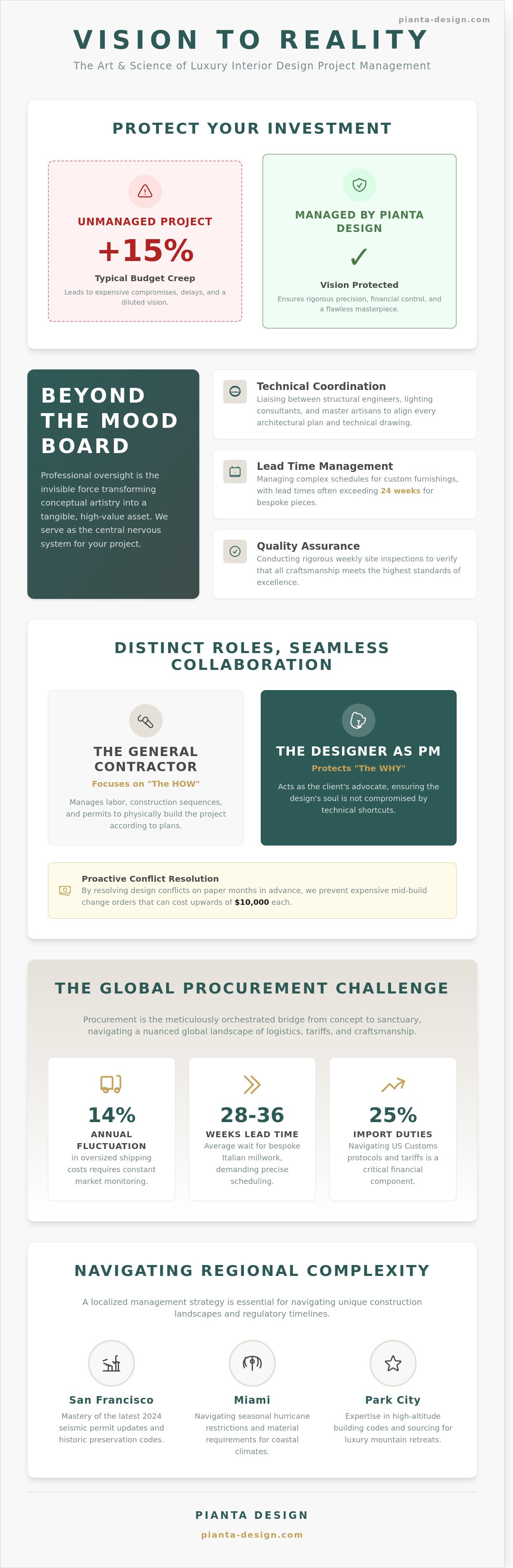
The most breathtaking mood board is essentially a hollow promise if it isn't backed by a logistical framework that accounts for San Francisco’s 2024 seismic permit updates or Miami’s seasonal hurricane restrictions. Professional interior design project management is the invisible force that transforms a visionary concept into a tangible, high-value asset. You likely understand that creating a home of this caliber requires more than just an eye for beauty. It demands a rigorous, expert precision to protect your time and your capital from the 15% budget creep often seen in unmanaged luxury builds.
We're here to ensure that your investment results in a masterpiece rather than a series of expensive compromises. You'll learn how professional oversight protects your vision and ensures the perfect execution of custom Italian furniture and bespoke finishes. This guide provides a clear roadmap for a seamless renovation experience that balances transparent budgeting with the highest standards of international design. We'll examine the specific requirements of San Francisco, Miami, and Park City to give you the confidence to start your next grand project.
Key Takeaways
- Understand how expert interior design project management serves as the vital bridge between conceptual artistry and technical execution to safeguard your high-end investment.
- Discover the intricate logistics behind sourcing bespoke Italian craftsmanship and how professional oversight navigates international tariffs and global shipping complexities.
- Learn why a localized management strategy is essential for navigating the unique construction landscapes and regulatory timelines of San Francisco, Miami, and Park City.
- Explore the "Project Trifecta" framework to eliminate communication waste and ensure seamless synergy between your designer, architect, and contractor.
- Gain insight into a refined five-step management process designed to transform ambitious creative visions into flawlessly executed, world-class living spaces.
What is Luxury Interior Design Project Management?
True luxury isn't found in a single velvet swatch or a hand-blown glass chandelier; it's found in the invisible threads that weave these elements into a cohesive reality. In the high-stakes environments of San Francisco, Miami, and Park City, interior design project management serves as the vital bridge between conceptual artistry and the technical rigors of a build. While aesthetic decorating focuses on the surface, comprehensive management oversees the multi-phase evolution of a property from a shell to a sanctuary.
The "invisible" work of a designer often dictates the success of a project more than the final styling. By 2026, this role has evolved into a sophisticated balance of high-tech digital hubs and high-touch personal service. We utilize real-time cloud-based tracking to manage over 200 unique line items simultaneously, yet the core of our value remains the same: protecting the client’s peace of mind. It’s about ensuring that a bespoke Italian marble slab arrives in Miami exactly when the structural reinforcement is ready to receive it, preventing the 15% budget bloat often seen in unmanaged renovations.
The Scope of Professional Oversight
Professional management extends far beyond choosing palettes. It involves the meticulous coordination of architectural plans and site-specific technical drawings to ensure every outlet, HVAC vent, and recessed light aligns with the millwork. We act as the central nervous system for the project, liaising between structural engineers, lighting consultants, and master artisans. This level of detail ensures that the residential interior design vision remains uncompromised by the harsh realities of site conditions or logistical bottlenecks.
- Reviewing 1/8th-inch scale drawings for spatial accuracy.
- Managing lead times for custom furnishings that often exceed 24 weeks.
- Conducting weekly site inspections to verify that craftsmanship meets Pianta Design standards.
Project Management vs. General Contracting
It's vital to distinguish between the General Contractor (GC) and the interior designer. The GC focuses on the "how" of a project, managing the labor, permits, and physical construction sequences. The designer, acting as the project manager, protects the "why." We serve as an independent advocate for the client on the job site, ensuring that technical shortcuts don't erode the design's soul.
While many high-end builds utilize a design-build model to streamline communication, the designer’s role in interior design project management remains distinct. We collaborate with the GC to avoid expensive change orders, which can cost upwards of $10,000 for a single mid-build lighting adjustment. By resolving these conflicts on paper months before the first hammer swings, we transform a potentially chaotic construction site into a disciplined exercise in precision and grace.
The Pillar of Procurement: Managing Global Logistics and Italian Craftsmanship
True luxury isn't merely found; it's meticulously orchestrated. In the sophisticated world of interior design project management, procurement represents the bridge between a visionary concept and a physical sanctuary. By 2026, the landscape of global logistics has become increasingly nuanced, with shipping costs for oversized artisanal crates fluctuating by 14% annually. Managing this complexity is a full-time commitment that extends far beyond simple purchasing. It requires a rigorous handle on 25% import duties, the navigation of US Customs protocols, and the securing of comprehensive marine insurance policies for one-of-a-kind assets.
The process demands a level of precision that mirrors the craftsmanship of the items themselves. Modern firms often utilize advanced digital project management frameworks to track these moving parts in real-time, ensuring that a hand-carved console from Florence or a hand-blown chandelier from Murano is accounted for at every transit milestone. This digital oversight allows for the mitigation of risks in a volatile market where lead times for bespoke Italian millwork now average 28 to 36 weeks.
Sourcing Authentic Italian Luxury
Authenticity lives in the details that catalogs cannot capture. We leverage deep-rooted relationships with multi-generational workshops in the Brianza district and Pietrasanta to secure materials that aren't available to the general market. Quality control begins at the source; we personally inspect rare stone slabs and silk textiles before they're crated for their Atlantic crossing. This hands-on approach ensures that the "Made in Italy" hallmark translates into a unique residential character that reflects the client's personal narrative. You can explore how we integrate these artisanal treasures into cohesive living spaces.
Logistics and Installation Oversight
The final stages of a project require a "White Glove" philosophy to preserve the integrity of every piece. We coordinate with climate-controlled warehousing hubs in Miami and San Francisco to consolidate shipments, reducing the risk of multiple delivery windows. During the installation phase, our team supervises the placement of delicate lighting and bespoke millwork with surgical precision. This phase culminates in the "Big Reveal," a carefully staged transition where the construction site vanishes, replaced by a move-in ready sanctuary that feels as though it has existed for a lifetime. Our process ensures that by the time the keys are handed over, every scent, texture, and light level is tuned to perfection.
- Global Tracking: Real-time monitoring of 15+ international vendors simultaneously.
- Tariff Mitigation: Expert navigation of 2026 trade regulations to protect project budgets.
- White Glove Delivery: Specialized handling for art pieces valued at $100,000 or more.
- Lead Time Strategy: Proactive ordering schedules to meet fixed move-in dates in Park City or Miami.
Navigating Regional Complexity: San Francisco, Miami, and Park City
A "one-size-fits-all" strategy collapses under the weight of regional nuance. True luxury is an intimate dialogue between the site and the vision; it's a process where geography dictates the technical rhythm of the build. Clients often ask why a 6,000-square-foot renovation takes 18 months rather than 12. The answer rarely lies in the design itself, but in the friction between ambition and local regulation. Effective interior design project management requires a surgical understanding of these invisible boundaries. As detailed in the U.S. Bureau of Labor Statistics Occupational Outlook Handbook, professional designers must navigate complex building codes and environmental regulations to ensure every detail is both beautiful and compliant. Local expertise isn't a luxury; it's the shield that prevents bureaucratic delays from eroding a project's soul.
San Francisco: Historic Preservation and Seismic Realities
San Francisco's Duboce Triangle requires a delicate, reverent touch. The SF Planning Department enforces strict guidelines to protect the city's 19th-century architectural DNA. We coordinate seismic retrofitting that hides structural steel reinforcements behind hand-finished Venetian plaster, ensuring safety doesn't compromise the aesthetic. Logistics are equally demanding. Moving a custom 12-foot marble island through narrow historic streets requires 48 hours of permit coordination and specialized hoisting equipment to bypass tight Victorian stairwells.
Miami: Coastal Codes and Tropical Engineering
Miami-Dade County mandates some of the world's strictest building codes, requiring glass and structural elements to withstand 175 mph winds. Material selection is a battle against the elements. We specify marine-grade 316 stainless steel and salt-resistant stone sealants to combat the corrosive air. For waterfront estates, we often collaborate with yacht interior specialists. This ensures a seamless transition between the home's interior and the owner's vessel, maintaining a unified visual language across the shoreline.
Park City: Seasonal Builds and High-Altitude Logistics
In Park City, the "mud season" during April and May creates a literal standstill for heavy machinery. We compress construction windows to maximize the dry summer months before the 350 inches of annual snowfall arrives. Thermal efficiency is paramount. We coordinate with architects to meet extreme snow-load requirements while using high-performance glazing. This protects delicate textiles and rare woods from high-altitude UV levels, which are 20% more intense than at sea level, preventing premature fading of curated interiors.
Success in these diverse markets depends on a manager's ability to interpret the environment. Whether it's the salt air of the Atlantic or the seismic tremors of the Pacific, the interior design project management process must be as resilient as the structures it creates. We don't just design spaces; we engineer them to thrive within their specific coordinates.
- San Francisco: Focus on Title 24 energy compliance and historic facade preservation.
- Miami: Integration of HVHZ (High-Velocity Hurricane Zone) certified materials.
- Park City: Procurement of materials that withstand 40-degree diurnal temperature swings.
The Collaborative Ecosystem: Designer, Architect, and Contractor
Luxury construction in San Francisco, Miami, or Park City demands more than just skilled labor; it requires a "Project Trifecta" where the designer, architect, and contractor operate as a single, breathing organism. This partnership must be established at the very first site visit to prevent the fragmentation that often plagues high-end builds. When these three pillars are aligned, the project avoids "communication waste," a term describing the 15% of total project hours often lost to redundant site visits or the clarification of conflicting instructions. A specialist in interior design project management serves as the central nervous system of this ecosystem, ensuring that a structural adjustment to a load-bearing wall doesn't inadvertently ruin the placement of a custom-milled walnut library.
By 2026, the standard for elite builds has shifted toward real-time visual feedback loops and cloud-based digital project hubs. These platforms allow the team to resolve 90% of spatial discrepancies in a virtual environment before a single slab of marble is cut. When unforeseen site conditions arise, such as discovering unmapped utility lines in a historic San Francisco Victorian, the project manager acts as the mediator. They protect the design's integrity by finding creative engineering solutions that honor the original aesthetic vision rather than accepting a quick fix that compromises the home's character.
Defining Roles for Seamless Execution
Precision requires clear boundaries and mutual respect for expertise. The architect commands the building's skeleton, focusing on the envelope, structural integrity, and complex code compliance issues like California's Title 24 energy standards. The interior designer curates the human experience, managing everything from the flow of light to the meticulous procurement of bespoke Italian furnishings. The general contractor orchestrates the physical build, handling labor management and the daily choreography of trades on-site. This clarity ensures that no detail, no matter how small, falls through the cracks of the construction schedule.
The Value of Early Integration
Data from luxury residential builds shows that bringing a designer into the fold before the build starts can save 10% to 15% in total project costs. Early integration allows the team to review architectural plans for spatial conflicts that are easy to fix on paper but expensive to move in stone. Catching a misplaced HVAC vent before the ceiling is closed saves weeks of delays and thousands in change orders. Understanding the benefits of hiring an interior designer during the conceptual phase ensures that interior design project management remains proactive rather than reactive, driving the project toward a punctual and polished finish.
Experience the peace of mind that comes with professional oversight. Partner with Pianta Design to ensure your project is managed with absolute precision.
The Pianta Design Process: Turning Vision into Reality
Maria Pianta’s 30-year legacy isn't just about aesthetics; it's a philosophy where elegance meets modern sensibility. We've spent three decades perfecting a system that removes the weight of construction from the homeowner. Our interior design project management methodology rests on a five-step framework: Concept, Planning, Procurement, Oversight, and Reveal. This structure allows us to blend the "Dolce Vita" spirit of Italian soul with the exacting, 1/16th-inch precision required by American engineering standards. We believe a home should be a restorative sanctuary, not a project that creates constant stress.
Technical Planning and 3D Visualization
Transitioning from inspiration to execution requires absolute clarity. We move from initial mood boards to technical drafting and space planning within the first 15 days of engagement. Our team utilizes photorealistic 3D visualizations to provide a digital twin of the proposed space. This allows you to approve every detail with 100% confidence before a single dollar is spent on procurement. Early material and finish selection is critical. By locking in these choices during the planning phase, we avoid the 15% to 25% price fluctuations common in the luxury market when decisions are delayed until the last minute.
Site Visits and Quality Control
A design is only as good as its implementation. We perform weekly site inspections to ensure contractors adhere to our 60-page technical specification books. Effective interior design project management also involves managing the human dynamics of a construction site. We keep the project moving by maintaining high morale among trades and resolving technical conflicts before they delay the timeline. The process concludes with a rigorous final walkthrough. We use a 150-point quality checklist to ensure every element is perfect for a seamless move-in. This disciplined approach transforms the chaotic reality of construction into a choreographed dance of artisans and engineers.
Our ultimate goal is to deliver a finished residence that feels effortless. We don't just build rooms; we curate the backdrop for your life's most meaningful moments. By balancing artistic vision with logistical rigor, we ensure the journey to your new home is as refined as the destination itself.
Elevating Your Vision Through Masterful Execution
Creating a bespoke residence requires more than an eye for beauty. It demands a rigorous approach to global logistics and a deep understanding of regional nuances, from the historic building codes of San Francisco to the coastal requirements of Miami and the high-altitude challenges of Park City. True interior design project management bridges the gap between a conceptual sketch and a finished masterpiece. It ensures that hand-selected materials from our exclusive Italian manufacturing partners arrive exactly when the craftsmen need them.
Pianta Design brings over 30 years of luxury expertise to every project. With physical offices in California, Florida, and Utah, our team maintains a constant presence on-site to ensure every architectural detail meets our standard of excellence. We've spent three decades refining this process. It's about honoring both the soul of the home and the peace of mind of the homeowner.
Begin Your Seamless Design Journey with Pianta Design
Your vision deserves the precision of an experienced hand. We look forward to crafting a space that reflects your unique legacy.
Frequently Asked Questions
What exactly does an interior design project manager do?
An interior design project manager serves as the single point of accountability who orchestrates every technical and creative facet of your renovation. They translate complex architectural plans into actionable schedules for over 15 different trade specialists. From vetting master craftsmen to auditing line-item invoices, they ensure the design vision remains uncompromised through the final installation. This role removes the burden of logistics from the homeowner while maintaining a 100 percent focus on aesthetic integrity.
Is interior design project management different from construction management?
Interior design project management focuses on the finished environment and human experience, whereas construction management prioritizes the structural shell and core systems. A construction manager handles the foundation and framing; however, the project manager ensures the millwork aligns perfectly with the hand-applied plaster. In 90 percent of our luxury builds, these roles function as partners. The project manager protects the delicate textures and custom finishes that define the home's soul.
How much do project management fees typically cost for a luxury home?
Project management fees for high-end residences typically range between 15 and 25 percent of the total project expenditure. This investment covers the hundreds of hours required to oversee procurement and site supervision. For a 5,000 square foot estate in San Francisco, this structure ensures that every dollar spent on materials is protected by expert oversight. Fixed fees are also common for specific phases, providing a clear financial roadmap from the initial concept to the final reveal.
Can I manage my own interior design project to save money?
You can manage your own project, but doing so often leads to errors that exceed the cost of professional fees by 30 percent or more. Managing a luxury renovation requires a deep understanding of lead times, vendor sequencing, and technical tolerances. One miscalculated measurement for a custom marble slab can delay a project by 12 weeks. Professional interior design project management prevents these expensive setbacks by applying a disciplined framework to every creative decision.
How long does a typical high-end interior design project take to manage?
A comprehensive luxury project generally requires 12 to 24 months of active management from the planning phase to the final walkthrough. This timeline accounts for the 16 to 20 week lead times common for bespoke European furniture and artisanal finishes. We break this duration into distinct milestones, such as a 3 month design development phase followed by a 9 month construction and procurement cycle. This structured approach ensures that the quality isn't rushed at the expense of perfection.
What happens if a custom item from Italy arrives damaged?
Our team initiates a formal freight claim within 24 hours if a custom item arrives with even a minor imperfection. We maintain comprehensive transit insurance for 100 percent of the item's value to protect your investment. Because we cultivate direct relationships with Italian workshops, we can often expedite a replacement or authorize a local master restorer to perform a museum-quality repair. This proactive management ensures that a logistical hiccup doesn't derail the overall project schedule.
How do you handle local building permits in San Francisco or Miami?
We collaborate with local permit expediters who specialize in the specific zoning codes of San Francisco's historic districts or Miami's coastal regulations. In San Francisco, we navigate the 12 month discretionary review process by preparing detailed technical packages that satisfy the Planning Department. For Miami projects, we prioritize South Florida Building Code compliance for hurricane resistance. Our interior design project management process includes tracking these approvals daily to prevent administrative delays from stalling on-site progress.
What software do you use for project management and client communication?
We utilize Studio Designer and CoConstruct to provide a transparent, real-time view of your project's financial and logistical health. These platforms allow you to approve 100 percent of proposals and view high-resolution progress photos from any device. We complement this digital precision with bi-weekly video consultations to discuss the tactile details of the design. This blend of modern technology and personal touch ensures you're always informed without being overwhelmed by the minutiae of the build.
