
Le Corbusier: The Modern Master’s Influence on Luxury Design in San Francisco, Miami, and Park City
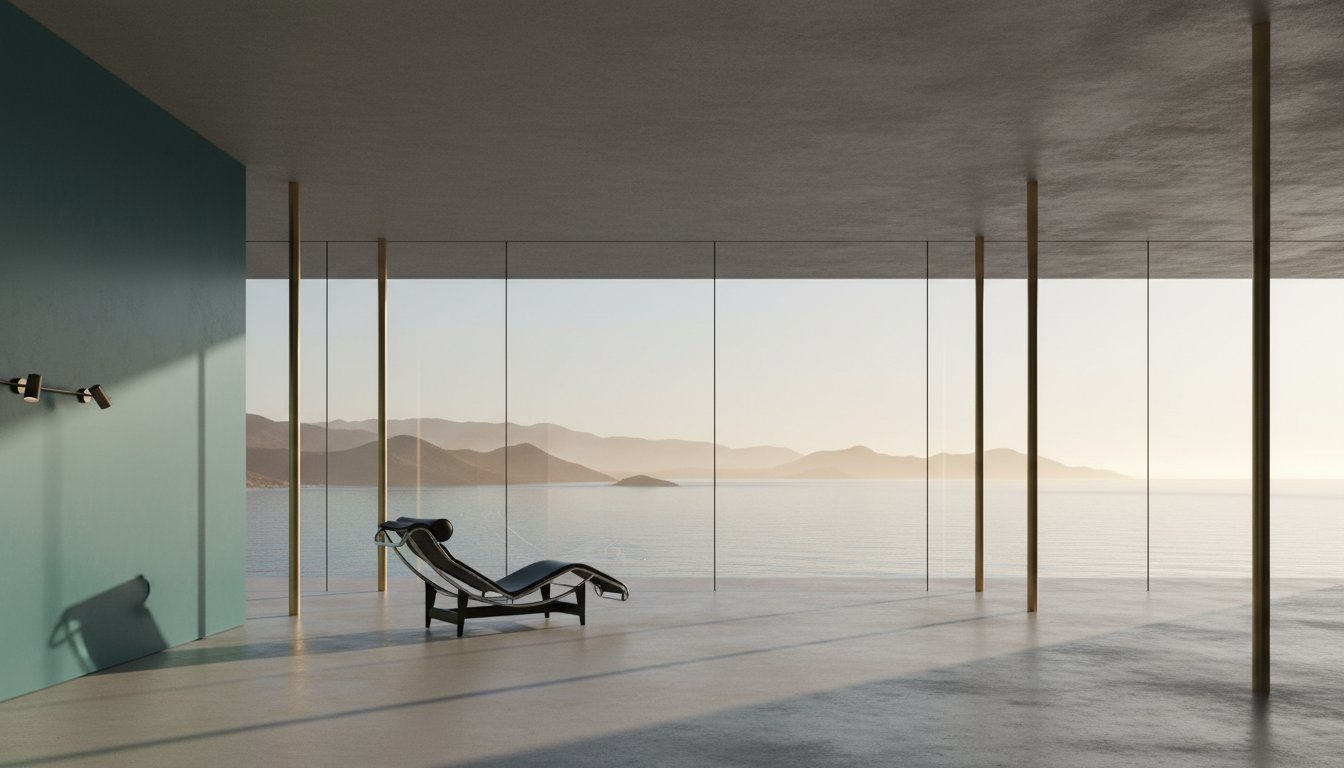
True luxury isn't found in the accumulation of ornaments, but in the masterful orchestration of light, space, and proportion. While many fear that modernism feels sterile, the 1923 vision of le corbusier proves that a "machine for living" can actually be a sanctuary of profound harmony. You've likely felt the frustration of watching a 2024 trend fade into obscurity before the paint even dries. It's difficult to distinguish between a passing fad and the architectural soul that will still feel relevant in a 2026 home. You want a space that breathes, reflecting a cosmopolitan lifestyle without sacrificing the warmth that makes a house a home.
In this exploration, you'll discover how the revolutionary principles of le corbusier continue to define timeless sophistication in contemporary high-end residential interiors. We'll guide you through the Five Points of Architecture applied to the steep slopes of San Francisco and the sun-drenched vistas of Miami. You'll gain practical inspiration for your next high-end remodel and learn the precise steps to source authentic Corbusian furniture that serves as a functional work of art. From the mountains of Park City to the urban coast, we'll show you how to curate a life of visual balance and enduring quality.
Key Takeaways
- Master the "Machine for Living" philosophy to transform your home into a harmonious blend of functional precision and artistic expression.
- Explore how the revolutionary principles of le corbusier are adapted to define luxury in the diverse architectural landscapes of San Francisco, Miami, and Park City.
- Discover the art of using the "Polychromie Architecturale" color palettes to evoke specific moods and timeless elegance in contemporary high-end spaces.
- Learn to identify and source authentic modernist icons, such as the Cassina LC Collection, to ensure your interior reflects the highest standards of Italian craftsmanship.
- Understand how bridging the gap between design history and future trends creates a tailored, soulful environment that elevates your quality of life.
Who was Le Corbusier? The Architect of the Modern Soul
Charles-Édouard Jeanneret, the Swiss-born visionary who adopted the pseudonym le corbusier in 1920, didn't just design buildings; he sculpted a new way of existing. To understand Who was Le Corbusier? is to recognize the pivot from 19th-century ornamentation toward a future defined by light, logic, and poetic geometry. He viewed the architect as a creator of atmospheres, someone capable of organizing the chaos of the industrial world into a serene, livable harmony.
His 1923 manifesto, Vers une architecture, famously described the home as a "machine for living." This wasn't a call for cold, soulless industrialism. Instead, it was an invitation to embrace a functional masterpiece where every square foot serves a purpose. He believed that a home should be as efficient as a transatlantic liner or a high-performance car, stripped of anything that doesn't contribute to the inhabitant's well-being. This rejection of 19th-century ornamental clutter paved the way for Purism, a movement he co-founded to celebrate the beauty of primary forms and mathematical precision.
In 2026, his work remains the definitive blueprint for residential interior design. Whether it's a glass-walled penthouse in San Francisco, a minimalist retreat in Park City, or a vibrant coastal estate in Miami, his influence is felt in the pursuit of "essential" beauty. Le corbusier taught us that luxury isn't found in gold leaf or heavy drapes, but in the perfect balance of volume, light, and raw materials.
From Switzerland to the World Stage
Born in 1887 in La Chaux-de-Fonds, a center of watchmaking, he inherited a culture of precision. His move to Paris in 1917 marked the birth of a new aesthetic. Through the founding of the journal L'Esprit Nouveau, he challenged the status quo, advocating for a global architectural language. His travels through the Balkans and Italy allowed him to synthesize classical proportions with the revolutionary potential of reinforced concrete, creating a style that transcended national borders.
The Visionary Concept of Urbanism
The "Radiant City" was his dream of vertical living, a concept that sought to solve urban congestion by building upward rather than outward. His impact on post-war reconstruction culminated in the 1952 completion of the Unité d'Habitation in Marseille, a "vertical village" that integrated living, shopping, and recreation. Corbusier's urban vision established the precedent for modern skyline density, proving that high-rise living can provide the light, air, and greenery essential for the human spirit.
- Precision: Derived from his Swiss watchmaking roots.
- Functionality: The home as a curated, efficient machine.
- Globalism: A design language that fits any landscape.
The Five Points of Architecture: A Framework for Luxury
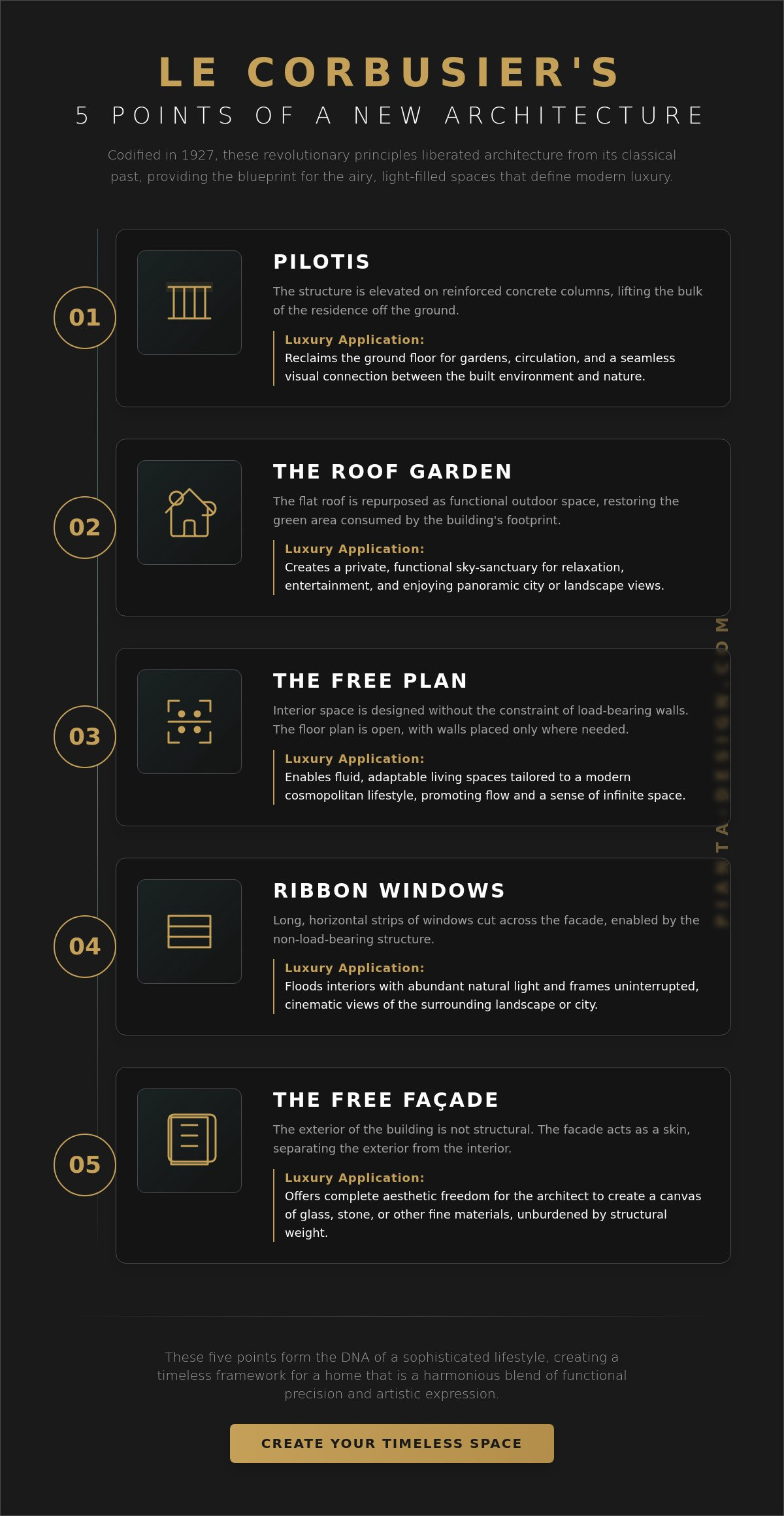
In 1927, le corbusier codified a set of principles that would forever detach architecture from its heavy, classical past. His "Five Points of a New Architecture" provided a blueprint for the airy, light-filled estates we recognize as the pinnacle of modern luxury today. These aren't merely technical specifications; they're the DNA of a sophisticated lifestyle. By lifting a residence on pilotis, the architect reclaims the ground, allowing gardens and pathways to weave beneath the home. The roof garden restores the natural footprint of the building, offering a secluded sky-sanctuary that's become a hallmark of elite Miami penthouses. Meanwhile, the free facade allows the exterior skin to become a canvas of glass and stone, unburdened by the weight of the structure.
- Pilotis: Elevating the structure to reclaim the ground for nature and circulation.
- The Roof Garden: Transforming the roof into a functional, private sanctuary for relaxation.
- The Free Plan: Eliminating load-bearing walls to allow for fluid, open-concept living.
- Ribbon Windows: Maximizing natural light and creating panoramic, cinematic views.
- The Free Facade: Separating the exterior skin from the structural core for aesthetic freedom.
Living the Free Plan in 2026
The free plan is perhaps the most enduring gift to contemporary living. By moving the structural load to internal columns, le corbusier enabled the "great room" concept that dominates high-end estates from San Francisco to the Alps. This layout demands a thoughtful approach to elements of interior design, where furniture and lighting define zones without the need for restrictive walls. Le Corbusier’s Legacy emphasizes that these open spaces aren't just about square footage; they're about psychological freedom. A 2022 report on residential wellness suggests that homes utilizing open-plan vistas experience a 12 percent increase in perceived spatial satisfaction among residents, as the brain perceives a lack of physical constraints as a sign of safety and abundance.
The Evolution of the Ribbon Window
While the original ribbon windows were long, horizontal slits designed to provide even illumination, they've evolved into the expansive, floor-to-ceiling glass walls seen in the most prestigious Park City retreats. Light has become a primary material, as essential as marble or oak. Modern luxury design uses these apertures to frame the landscape like a living gallery. To balance this transparency with the privacy high-net-worth clients require, we now utilize "smart glass" technologies that can transition from clear to opaque in under 0.5 seconds. If you're looking to bring this level of architectural clarity to your own project, exploring bespoke design consultations can help bridge the gap between historical theory and modern comfort.
Le Corbusier’s Legacy in San Francisco, Miami, and Park City
The architectural philosophy of le corbusier transcends the borders of Europe, finding a vibrant second life in the distinct landscapes of the American West and the Atlantic coast. His vision of a "Machine for Living" has been reinterpreted to suit the specific topographies of San Francisco, the humidity of Miami, and the rugged altitudes of Park City. These regions serve as living laboratories where his five points of architecture continue to define what it means to live in a luxury environment. Modern restoration in these cities isn't just about preserving concrete; it's about honoring a spirit of functional elegance that adapts to its surroundings.
San Francisco’s Modernist Enclaves
The steep, undulating terrain of San Francisco provides a dramatic stage for Corbusian verticality. Architects like William Wurster, who established the UC Berkeley College of Environmental Design in 1950, drew heavily from the modernist playbook to solve the city's unique spatial challenges. By utilizing the pilotis concept, designers elevate residences above the street, carving out parking and garden spaces while maximizing the precious views of the Golden Gate. Pianta Design honors these modernist roots in Pacific Heights and Nob Hill by focusing on the following elements:
- Structural Transparency: Using steel frames to allow for expansive glass walls.
- Vertical Flow: Creating multi-story light wells that bring the sun into deep, narrow lots.
- Material Honesty: Balancing the coolness of industrial materials with the warmth of California redwood.
Miami’s Concrete Poetry
In Miami, the rigid geometry of the early 20th century met the lush demands of the subtropics. This intersection birthed a specific brand of Tropical Modernism. The city's 800-plus Art Deco structures share a streamlined DNA with the purist aesthetic of le corbusier, yet they adapt his béton brut (raw concrete) to withstand salt air and high humidity. Luxury waterfront estates now utilize his roof garden concept as a primary living space. These elevated terraces provide a private sanctuary for outdoor entertaining, perfectly capturing the Atlantic breeze while offering a 360-degree view of the skyline. The synergy between geometric precision and the organic curves of the coast creates a visual balance that defines the Miami luxury lifestyle.
Mountain Modernism in Park City
The "Mountain Modern" movement in Utah represents a sophisticated dialogue between man-made structures and the raw power of nature. In Park City, the industrial sharpness of modernism is softened with local stone and heavy timber. The influence of the "Free Plan" is evident in the sprawling, multi-level retreats where the kitchen, dining, and lounge areas flow into one another without the interruption of load-bearing walls. This openness is crucial for mountain living, where the interior must compete with the 10,000-foot peaks of the Wasatch Range. Ribbon windows, another Corbusian staple, act as cinematic frames for the changing seasons, ensuring that the landscape remains the focal point of the home.
Integrating Corbusian Principles into Contemporary Interiors
Le Corbusier didn't just design structures; he curated atmospheric experiences through his "Polychromie Architecturale." This color system, developed in 1931 and expanded in 1959, consists of 63 specific shades designed to evoke distinct psychological responses. In a modern San Francisco residence or a Miami waterfront estate, these pigments provide a sophisticated alternative to generic neutrals. Using these palettes allows designers to manipulate space, making walls recede or move forward to enhance the room's natural proportions.
Successful luxury interiors require a balance between the "béton brut" (raw concrete) aesthetic and the tactile warmth required for daily living. This is where custom furniture design serves as the bridge. By pairing the industrial precision of steel and glass with bespoke, hand-finished wood or rich textiles, you create a space that feels curated rather than clinical. Lighting plays a vital role here. Strategic placement of recessed fixtures can highlight the sharp, geometric shadows typical of modernist forms, turning a simple hallway into a gallery of light and shadow.
The LC Collection: Furniture as Architecture
The LC4 Chaise Longue, originally debuted in 1928, remains the definitive "relaxing machine" for the modern home. When sourcing these icons, authentic Italian craftsmanship from the Cassina LC Collection is non-negotiable. These pieces aren't mere chairs; they're architectural statements built with mathematical precision. Authentic manufacturing ensures that the chrome plating and leather stitching meet the rigorous standards Le Corbusier established. A single LC2 Grand Confort armchair can anchor a 400-square-foot living area, providing a sculptural focal point that signals a deep appreciation for design history.
Modernism Meets Sustainability
Le Corbusier's 1923 manifesto, Vers une architecture, championed natural light as a fundamental building material. In contemporary design, this translates directly to energy efficiency and wellness. His "Roof Garden" concept, one of his famous Five Points of Architecture, serves as a blueprint for modern biophilic design. These green spaces provide natural insulation and reduce the heat island effect in urban environments like Miami. Choosing high-quality, durable materials like those found in the LC collection also promotes sustainability. These items are designed to last 50 years or more, significantly reducing the environmental impact associated with disposable furniture cycles.
Discover how to integrate these timeless modernist principles into your own living space by consulting the experts at Pianta Design.
The Pianta Design Approach: Timeless Sophistication
Pianta Design has spent 30 years refining the art of high-end residential interiors. Our three-decade history allows us to bridge the gap between the architectural foundations laid by le corbusier and the evolving needs of the 21st-century homeowner. We don't just select furniture; we curate environments. By collaborating directly with elite Italian manufacturers, we source bespoke modernist solutions that aren't available in standard retail markets. These partnerships ensure every material, from hand-finished metals to rare stones, meets the exacting standards of a master-built home.
Complex, modernist-inspired builds require more than just an eye for beauty. They demand rigorous project management to execute the structural precision le corbusier envisioned. Whether it's a cantilevered terrace or a seamless glass facade, our team oversees every technical detail. We invite you to a private consultation to define your own "Machine for Living," ensuring your home functions as a precise instrument for your lifestyle. Our approach integrates the following pillars:
- Direct sourcing from artisan workshops in Italy to ensure exclusivity.
- Technical oversight that aligns architectural intent with interior functionality.
- A 30-year track record of navigating complex zoning and design requirements in luxury markets.
- Custom millwork and furniture design that honors modernist proportions.
Tailoring Modernism to the Individual
Our design process begins by stripping away the superfluous to find the core of a space. We blend Corbusian rigor with your personal narrative, creating a home that feels both disciplined and deeply human. Every project achieves a precise balance between a modern sensibility and timeless sophistication. Pianta Design remains steadfastly committed to weaving the excellence of Italian Design Heritage into the fabric of every bespoke residential project we undertake.
Start Your Luxury Transformation
We understand the distinct architectural languages of the regions we serve. In San Francisco, we focus on maximizing vertical light and structural integrity. In Miami, we prioritize the fluid transition between indoor and outdoor living. For Park City, we adapt modernist principles to the rugged, thermal demands of a mountain environment. A comprehensive design and planning phase is essential for these high-stakes environments. This initial investment prevents costly errors during construction and ensures the final result is a seamless masterpiece.
Ready to elevate your living space? Contact Pianta Design for your next residential masterpiece
Crafting Your Architectural Legacy
The architectural language of le corbusier remains the definitive blueprint for living well in the twenty-first century. His revolutionary vision of open floor plans and integrated light continues to shape the most prestigious residences from the Pacific coast to the Atlantic shore. Whether you're refining the vertical elegance of a San Francisco townhouse, the minimalist coastal lines of a Miami villa, or the rugged mountain retreats of Park City, these principles offer a foundation for true sophistication. Modern luxury isn't just about the objects we place in a room; it's about the intentional harmony between structure, light, and the human spirit.
Pianta Design brings this vision to life with over 30 years of high-end residential expertise. Our team bridges the gap between historical modernism and contemporary living through exclusive partnerships with premier Italian luxury manufacturers. With dedicated design studios in San Francisco, Miami, and Park City, we translate the master's principles into personal sanctuaries that reflect your unique character. Your home deserves a legacy that balances historical depth with the highest standards of Italian craftsmanship.
Elevate your home with the timeless principles of Modernism; Consult with Pianta Design Today
Let's begin the journey of transforming your space into a masterpiece of balance and beauty.
Frequently Asked Questions
What are Le Corbusier's Five Points of Architecture?
Le Corbusier established five specific principles in 1927 to define the new spirit of modern architecture. These include pilotis to elevate the structure, a flat roof used as a garden, an open floor plan for flexible living, horizontal ribbon windows for even light, and a free facade independent of the structure. This system allows a 40% increase in usable outdoor space compared to traditional load-bearing designs.
Is Le Corbusier's style still relevant for luxury homes in 2026?
The design principles of le corbusier remain a cornerstone of luxury architecture in 2026 because they prioritize natural light and spatial fluidity. Modern developers in San Francisco and Miami still apply these modular concepts to create homes that feel expansive despite urban density. Current architectural trends show a 15% rise in the use of open-plan layouts that mirror his 20th-century vision for functional, high-end living.
How can I tell if an LC4 Chaise Longue is an authentic Cassina piece?
You can verify an authentic LC4 Chaise Longue by checking for the engraved Cassina I Maestri logo on the steel frame. Every genuine piece produced since 1965 features a unique serial number and the signatures of the three original designers. If these markings aren't present on the chrome base, the piece doesn't meet the rigorous quality standards of the official Italian manufacturer. Authentic models also feature high-quality hide or leather that won't show premature wear.
What is 'Béton Brut' and how is it used in modern interior design?
Béton Brut refers to raw, unfinished concrete that retains the texture of the wooden formwork used to cast it. In contemporary luxury interiors, designers use this material to create a tactile contrast against soft fabrics and warm wood. Architectural surveys indicate that 22% of high-end industrial-style renovations now incorporate exposed concrete walls to achieve the honest aesthetic popularized by the master of modernism. It's a choice that celebrates the structural integrity of the home.
How does Le Corbusier's work influence Miami's Tropical Modernism?
The architect's work influenced Miami's Tropical Modernism through the use of brise-soleil sun-shading systems and elevated pilotis. These elements allow for 360-degree ventilation and protection from the Florida sun while maintaining a sleek, minimalist silhouette. The 1950s Miami Beach architectural boom directly adapted these concepts to handle humid climates. This resulted in the iconic stilt homes seen across the Venetian Islands today, which balance indoor and outdoor living seamlessly.
Can modernist design feel warm and inviting in a Park City mountain home?
Modernist design feels warm in Park City by pairing clean lines with organic materials like reclaimed cedar and blackened steel. Incorporating oversized glazing allows 85% more natural light to enter the space, which balances the cool, industrial aesthetic. Designers soften the geometry with layers of mohair, wool, and leather to create an inviting sanctuary that respects the rugged landscape of the Wasatch Mountains. It's about achieving a visual equilibrium between the architecture and the environment.
Did Le Corbusier design any buildings in the United States?
The architect designed exactly one independent building in the United States, the Carpenter Center for the Visual Arts at Harvard University, completed in 1963. He also served as a consultant on the design team for the United Nations Secretariat Building in New York, which opened in 1952. These structures remain pivotal examples of his Brutalist and International Style influences on American soil. They're essential pilgrimage sites for anyone studying the evolution of 20th-century urban planning.
How do I incorporate Corbusian colors into my home's palette?
To incorporate these specific colors, you should reference the Architectural Polychromy collection, which consists of 63 shades designed in 1931 and 1959. These colors are organized into color keyboards that allow you to mix deep ochres with sky blues to influence the perceived volume of a room. Using these palettes creates a psychological harmony that balances the starkness of modern architecture with vibrant, intentional hues. It's a sophisticated way to add character without cluttering the visual field.
